
Discover Brancusi’s Legacy



Young Girl in Love
Torso of a young girl with truncated legs, her head hidden beneath abundant hair. The modest gesture of the arms, along with the forms, symbolizes blind love and femininity. The sculpture exhibits cubist lines, blending sensuality, balance, and geometry, characteristic of Brancusi’s Parisian period (1907–1909).
10/29/20253 min read
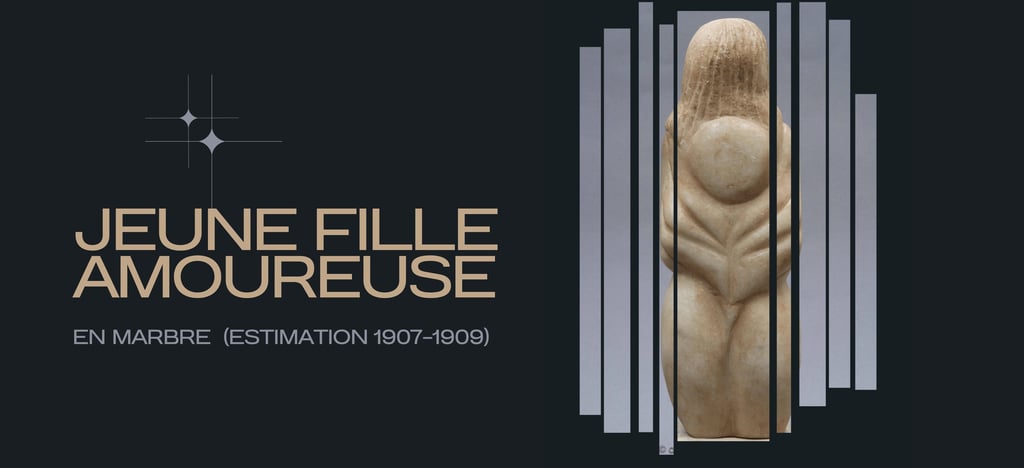

The sculpture depicts the torso of a young girl with legs truncated above the knees, her head completely hidden beneath abundant, carefully combed hair—a hallmark of Brancusi’s style, giving the impression of hair flowing in torrents. The arms are closely pressed against the body, directed toward the genital area in a modest gesture, as if covering her nudity (photo 1).
The torso symbolizes a young girl in love whose feelings have become blind (“love is blind”): the artist obscures her face with her cascading hair, while a more pronounced rounded area in the chest region may symbolize an ovary (reflecting the saying, “a woman in love thinks and feels with her ovaries”). Brancusi reused this rounded form in later works to represent the kiss, couples of lovers, or the cell (egg/ovule) from which a new being is born through division—symbols also seen in The Gate of the Kiss in Târgu-Jiu.
The gluteal muscles are well defined on the dorsal side of the torso (photo 2), though the artist omitted them in the 1909 torso (collection of the Craiova Art Museum, Romania).
Description of Young Girl in Love (1907–1909)
Photo 2
Photo 1
The sculpture has a slight patina and retains traces of ochre paint (clay used as a pigment for painting), a technique Brancusi employed under the influence of ancient statues, at a time when it was customary to paint marble. When the artist became interested in the intrinsic structure of the material, he abandoned this practice.
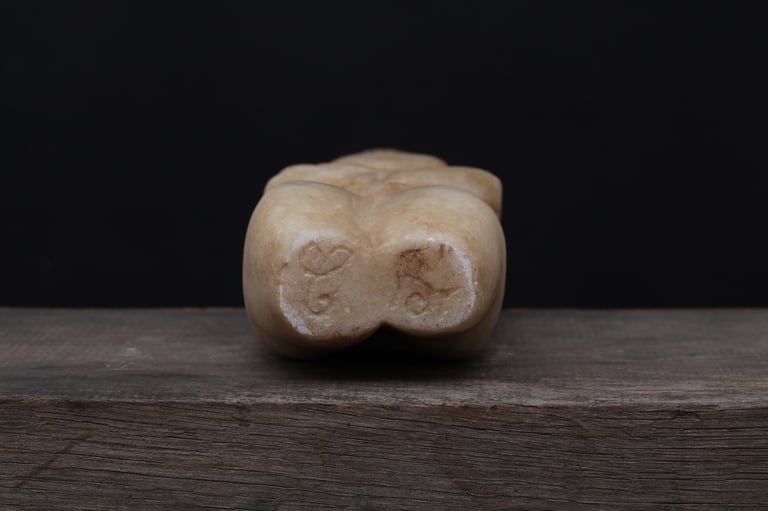
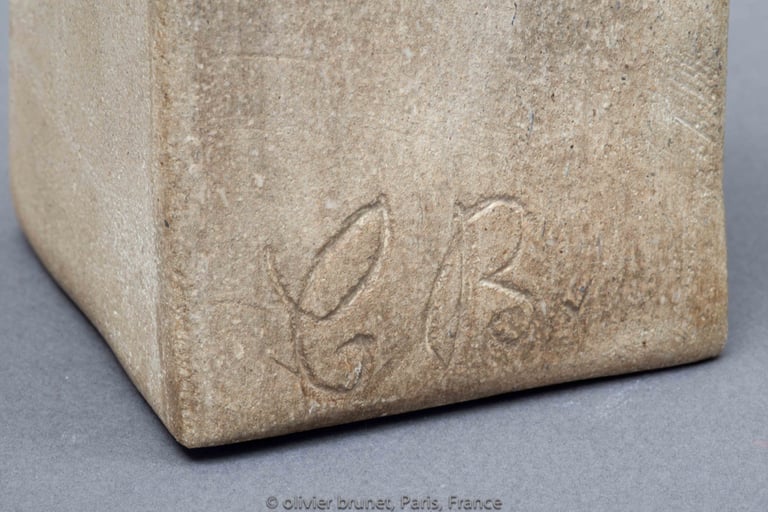
The torso is signed at the base with an incised inscription in calligraphic letters: C Br (photo 6). The stone pedestal, of truncated pyramidal shape, bears the same signature on the large lower trapezoidal surface (photo 7).
The dimensions and proportions were carefully chosen to give the pedestal the appearance of a rectangular parallelepiped when viewed from the front or back (photo 8), and that of a truncated pyramid when seen from the side (photo 9).
---------------------------
Photo 3
Photo 4
Photo 6
Photo 5
Photo 7
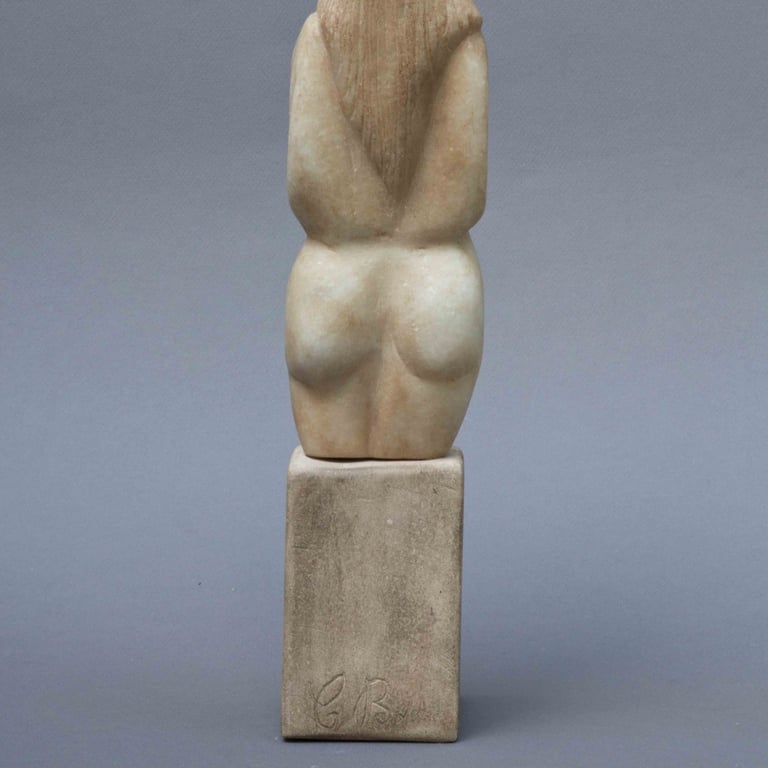
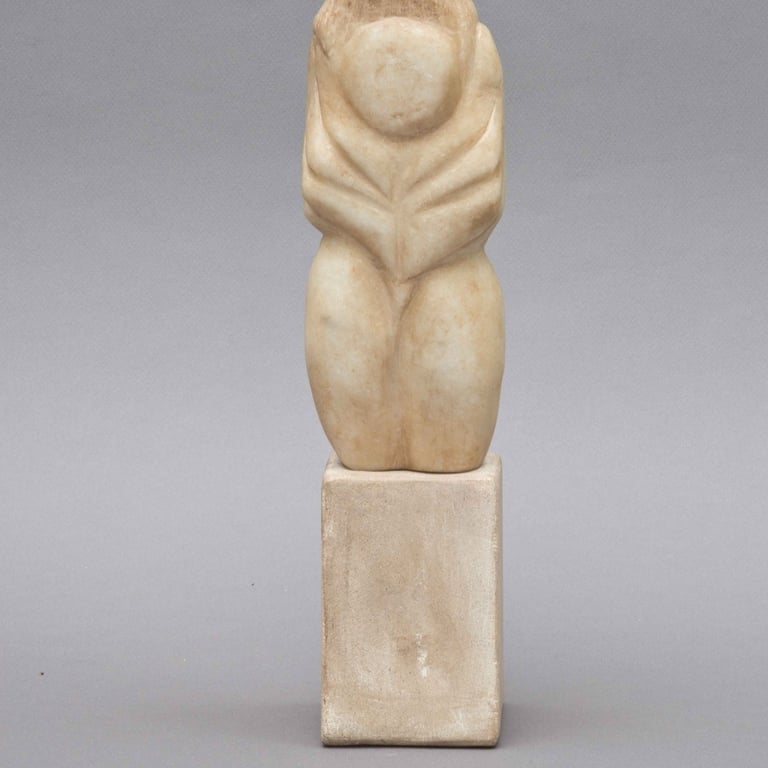
A general observation of the work reveals multiple geometric shapes—triangle, circle, rectangle, trapezoid, straight lines, and some slightly curved forms of Cubist influence—which situates the sculpture within Brancusi’s Parisian period, between 1907, marking the beginnings of Cubism, and 1909, when the artist adopted a renewed approach to the torso.
Another characteristic, typical of Brancusi’s interest in engineering techniques, lies in the fact that the torso can only maintain its balance in a single position, ensuring that the signature on the pedestal remains at the back. This feature results from a slight irregularity in the surface of the pedestal’s base, deliberately sculpted by the artist.
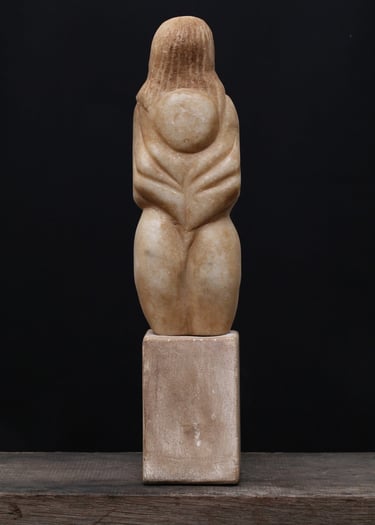
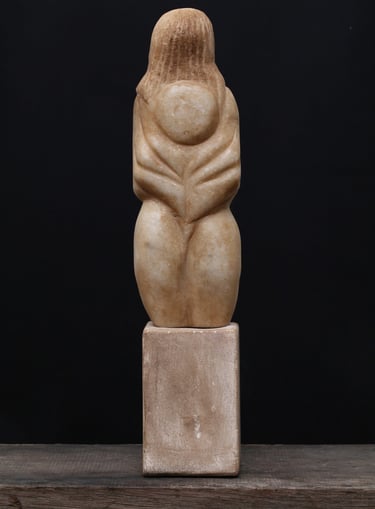
The sculpture features several stylized arms of different forms (photo 3), delineated by carved recesses in the marble: those at the front are directed toward the genital area, while the arms on the sides evoke forms similar to those seen in The Kiss (right side, photo 4) and, later, in Mademoiselle Pogany (left side, photo 5).
Observing the median line of the piece, an asymmetry between the two halves becomes apparent, noticeable in the shape of the thighs (photo 1), the buttocks (photo 2), and the arrangement of the hair over the right and left shoulders (photos 4 and 5). One can say that the left side appears more masculine than the right, yet together they form a single being, in perfect harmony.
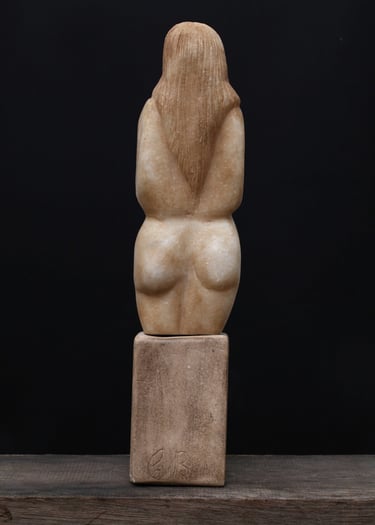


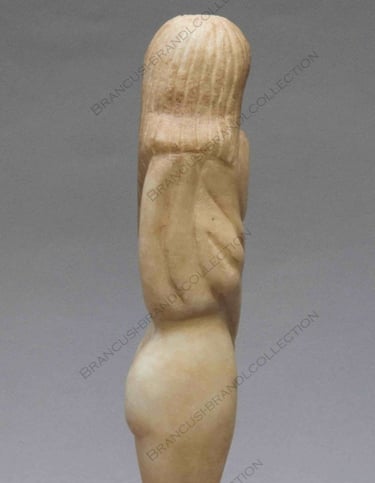


Photo 8
Photo 9
Other articles you may like
Contact
For any questions, contact us here.
Follow us
Subscribe
© 2025. All Rights Reserved.