
Discover Brancusi’s Legacy



Traian Vuia – A Century of Aviation
This article traces the life and achievements of Traian Vuia, an aviation pioneer born in Romania in 1872. It recounts his journey from his studies in Budapest and Paris to his historic first flight on March 18, 1906, in Montesson, where his aircraft Vuia No. 1 took off using only its own power—a world first. The article also addresses his mechanical inventions and international patents, his experiments with engines and helicopters, as well as his patriotic commitment during both World Wars.
10/31/20254 min read
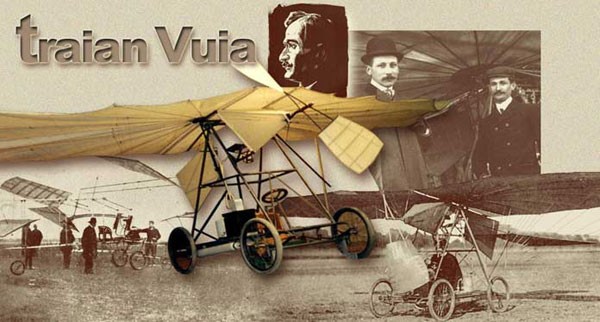
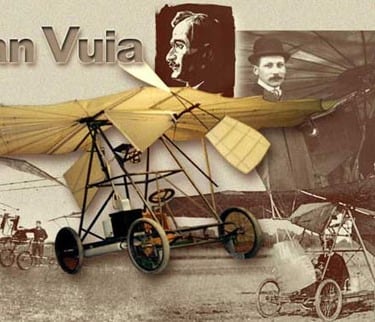
Traian Vuia was born on August 7, 1872, into a Romanian family in the village of Surducul Mic (today Traian Vuia), in the Banat region, then under Austro-Hungarian rule.
After completing primary school in his village, he continued his secondary education in Lugoj, where he obtained his diploma in 1892. Passionate about mechanics and especially aeronautics, Vuia dreamed of flying from an early age.
Lacking financial means, he was able to attend only one year at the Polytechnic School of Budapest, but later managed to enroll in the Faculty of Law in the same city, while working as an assistant in a law office. He graduated in 1901 and was awarded the title of Doctor of Law. On June 27, 1902, he left for France, where he lived until 1950, before returning to Romania gravely ill. He died on September 3, 1950.
In February 1903, Vuia submitted a memoir to the Paris Academy of Sciences describing a monoplane project he called an “aeroplane-automobile.” The project was rejected, as flight by a heavier-than-air machine was then considered a “chimera.” Nevertheless, on May 15 of the same year, he filed his invention with the National Office of Industrial Property and obtained patent no. 332106 for his flying machine.
He began building his aircraft in the Hockenjos & Schmitt workshop in Courbevoie, completing it at the end of 1905 thanks to the financial support of several friends from Lugoj.
The Vuia No. 1 monoplane consisted of a triangular steel-tube frame mounted on four pneumatic wheels (a first in Europe), pivoting wings with a span of 2.10 meters, and a tractor propeller engine. It was controlled by a rudder and by varying the incidence of the wings. The 20-horsepower Serpollet-type engine ran on steam modified by Vuia to use vaporized liquid carbon dioxide—but could operate only for a short time.
On February 5, 1906, in the presence of several notable figures—the Duke and Viscount Decazes, George and Gaston Besançon, Gustave Hermite, among others—Vuia carried out his first tests near Paris.
In the journal L’Aérophile (February 1906), the official organ of the Aéro-Club de France, Mr. Masfrand reported on his experiments and published a photograph of the machine, emphasizing that it “had the advantage of eliminating the artificial means previously used to launch aeroplanes, such as kites, rails, inclined planes, or towing automobiles.”
In L’Aérophile of June 1906, it was recalled that the Vuia I aeroplane “had been publicly tested as early as February 1906, well before all other contemporary machines.” And in September 1906, an editorial noted:
“It is only fair to recall that Mr. Vuia was the first in France to attempt, with a machine capable of carrying a man, the direct takeoff of a wheeled, propeller-driven aeroplane.”
On March 18, 1906, at Montesson near Paris, Vuia successfully achieved a flight of 12 meters at a height of one meter, without any external assistance. This flight was reported in L’Aérophile, Nature, L’Auto (1906), The New York Herald (March 3, 1907: “Vuia Airplane Makes a Successful Flight”), L’Aéronautique (1923), and many other historical works.
The first restored model of the Vuia No. 1 is exhibited at the Musée de l’Air et de l’Espace at Le Bourget, Paris, bearing the inscription:
“On March 18, 1906, six months before the flight of Santos-Dumont, Vuia took off with his monoplane from the road at Montesson and flew 12 meters at one meter above the ground.”
Replicas also exist at the National Military Museum in Bucharest and at the headquarters of ICAO in Montreal, Canada.
On the façade of Montesson’s town hall, a commemorative plaque recalls that it was there that Vuia achieved the first autonomous takeoff of a heavier-than-air machine.
Further flights followed in June, August, and October 1906, reaching distances of up to 24 meters. In 1907, Vuia equipped his new aircraft, Vuia No. 1 bis, with a 24-horsepower Antoinette engine. He later tested the Vuia No. 2 at Juvisy and Issy-les-Moulineaux.
The historian Charles Gibbs-Smith later wrote that “Vuia’s monoplane, the first conventionally shaped aircraft in history, probably influenced Blériot to abandon the biplane in favor of the monoplane.” Vuia was also the first to use welded steel tubes, nearly ten years before Fokker’s Spinne.
He subsequently turned his attention to Stirling-cycle engines and instantaneous steam generators, filing numerous patents in France, Belgium, Canada, and Hungary.
During the First World War, Vuia undertook studies on helicopters, published in 1929 under the title Experimental Studies on Rotating Inclined Planes. In 1920, he filed a U.S. patent for a propulsion system, and in 1921, a French patent for “improvements in means of lift.” He built two helicopter prototypes tested at Juvisy and Issy-les-Moulineaux, among the earliest experiments of this kind in the world.
In the 1920s, Vuia also developed catalytic combustion generators, earning 19 international patents. His research was interrupted by the Second World War.
On the 50th anniversary of the first mechanical flight (March 18, 1956), the journal Flight wrote:
“Vuia was a man of great modesty. He never claimed any merit other than having demonstrated, as early as 1906–1907, that powered flight was a reality.”
Charles Dollfus, curator of the Musée de l’Air in Paris, added:
“His machine was the first to be fitted with pneumatic wheels. Santos-Dumont drew inspiration from it for his own flights. Though limited, Vuia’s work was of capital importance because of the quality of its design and its experimental courage.”
Finally, in Wings of History – The Air Museums of Europe (1989), Louis and Judene Divone recalled:
“On March 18, 1906, Traian Vuia was the first man to take off from flat ground using only the power of his engine. He continued his research and, in 1922, his helicopter was among the very first to fly.”
A committed patriot, Vuia led the Romanian community in France during both World Wars, supporting the resistance and assisting Romanian delegations during the peace treaties.
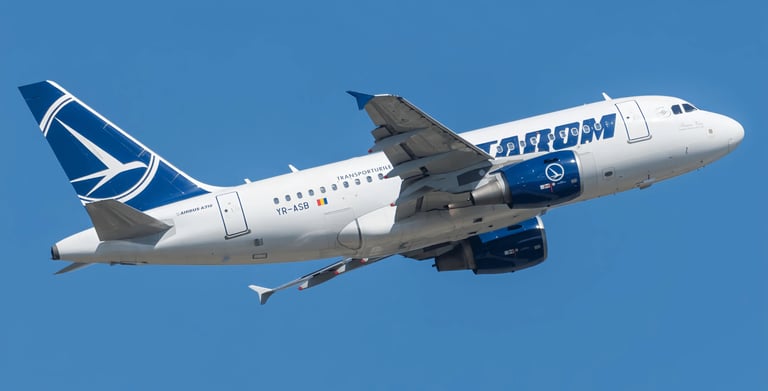
Airbus Traine Vuia
Other articles you may like
Contact
For any questions, contact us here.
Follow us
Subscribe
© 2025. All Rights Reserved.