
Discover Brancusi’s Legacy



The Unknown Kiss by Brancusi
A Kiss found in a private collection, previously unknown, measures 26 × 14 × 10 cm and weighs 8 kg (Figures A). By its texture, color, and the density characteristic of its material, the sculpture is made of sandstone.
THE KISS
10/23/20254 min read
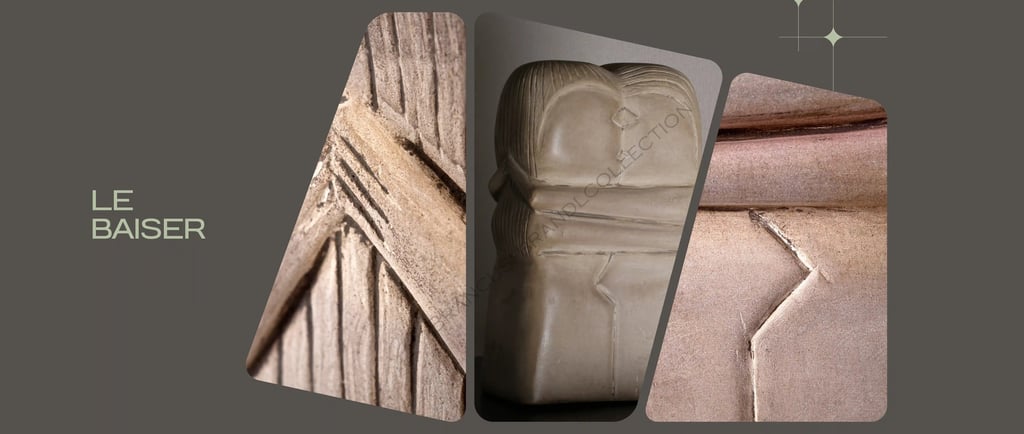
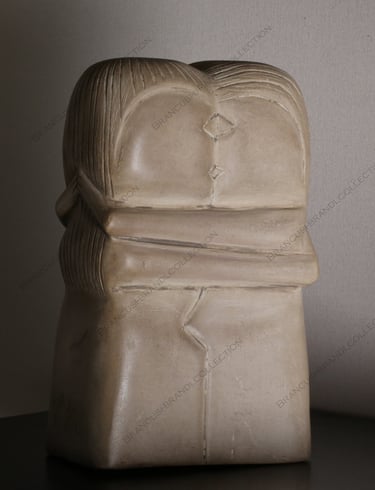
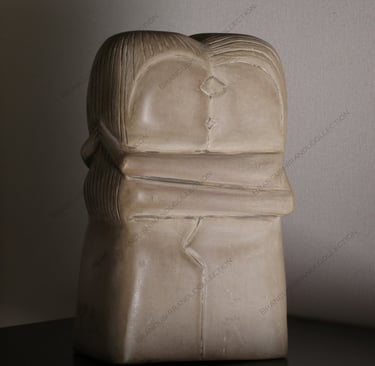
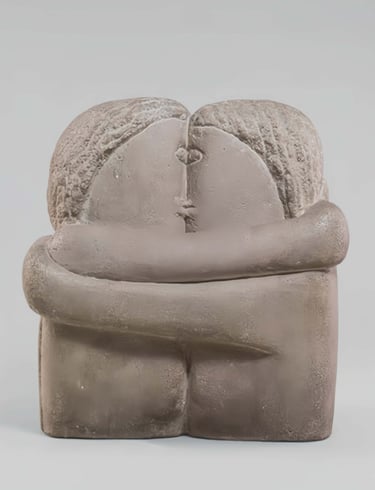


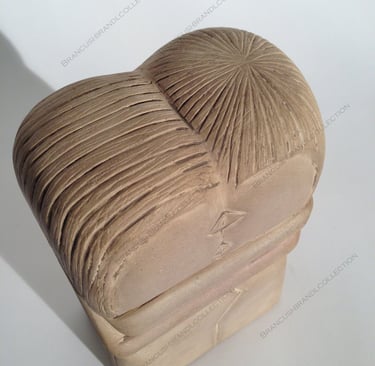
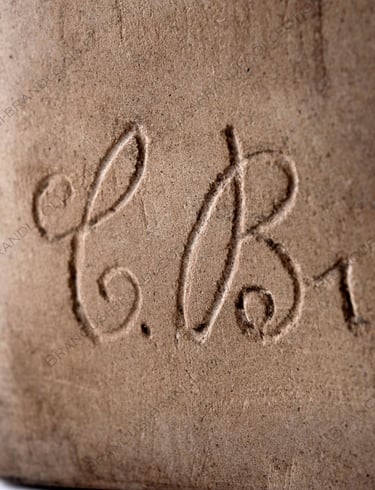
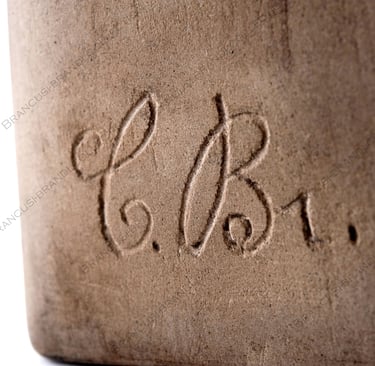
FIGURE A: The Kiss, sandstone, 1907–1908 – frontal view; dimensions: 26 × 14 × 10 cm.
FIGURE B: The Kiss, Marne stone, 1907; dimensions: 28.0 × 25.0 × 21.5 cm; signed “Brancusi” at the base, undated (Craiova Art Museum).
FIGURE A-1: The Kiss, sandstone – top view: 26 × 14 × 10 cm.
FIGURE A-2: The Kiss, sandstone – signature incised in the stone.
In terms of height and certain stylistic elements, this piece is close to the Kiss shown in Figure B. Its proportions give it suppleness, while the length and arrangement of the hair (Figures A-1) are similar, though here the strands are straight rather than wavy, and the figures are completely exposed.
The contours of the eyes are recessed into the stone, as are the joined lips. The slender, rounded arms encircle the stone block in which the lovers’ busts are carved, without extending beyond it—seen from above, the Kiss appears as an almost perfect rectangular parallelepiped (Figure A).
The hands are delicate, ending in fine, tapering fingers. This time, the man is slightly taller than the woman, a detail as subtle as in the Kiss of 1907. Another difference lies in the pointed shape of the woman’s breasts, which “touch” the man’s chest. The eyes and lips seen in profile are rendered as two triangles joined at the base, forming a rhombus.
The woman’s breasts are defined by sharp angles along the dividing line between the man’s and woman’s torsos. These cubist features help us attribute the sculpture to the period 1907–1908, since the artist did not date it. The sandstone Kiss is signed in calligraphic letters, incised in the lower part of the left side: C. Br. (Figure A-2).
Conclusions
The series of stone sculptures on the theme of The Kiss by Brancusi includes nine freestanding pieces carved in gray or yellow limestone, now found in museums and private collections in Romania, France, and the United States.
The Kiss of 1907 inaugurated this series, considered to be the first work of modern sculpture executed without preliminary sketches or measurements — in effect, a declaration of independence from Auguste Rodin, in whose studio Brancusi had worked as an assistant for just over a month, seeking to free himself from Rodin’s influence in order to find his own artistic path.
In Brancusi’s creative process, sculptures in stone, wood, clay, or marble generally served as an intermediate stage toward the bronze versions. Notably, all known versions of The Kiss were made in stone; for some, he produced plaster casts, but never cast them in metal.
The discovery of a new version of The Kiss, which enriches the world’s artistic heritage, is cause for celebration, as it reveals an artist deeply engaged in exploring a theme both artistic and philosophical, while remaining faithful to his central aim in art: to express the essence of things.
This Unknown Kiss, found in a private collection and analyzed in this study, completes the series of sculptures on this theme executed by Brancusi over nearly fifty years. The work holds a special place owing to the nature of its material — sandstone — a medium Brancusi never used elsewhere, likely due to its exceptional hardness (6.5–7 on the Mohs scale), greater than that of limestone or marble (3–4 on the Mohs scale).
Its proportions also differ from the others, lending the piece an unusual suppleness and elegance. The stylistic elements of cubist influence make it particularly engaging and place it close to the Kiss created in 1907.
Why did Brancusi choose to represent the monument of love through the bust rather than the full figure? Even in the funerary stele and the Border Column, it is always the bust that is emphasized, the feet merely suggesting the rest of the body.
The artist chose the bust because it contains the organs of love: the heart, symbol of pure affection; the eyes, mirror of the soul through which light enters and radiates outward; the lips, channel of connection through which pure energies are exchanged; and the arms, holding the bodies tightly together for eternity, fusing them into one.
Brancusi sculpted lovers without age and without physical allure — quite the opposite — for love, in his view, is experienced within, in the invisible realm, not in outward form. It is exalted, and therefore needs no earthly support or connection.
On the meaning of The Kiss, Brancusi often said:
“I intended, through the sculpture The Kiss, not only to recall that unique pair of lovers, but also all the other couples (anonymous) who have ever loved in this world—before leaving it... Each of my sculptures was born of a very deep feeling.”
---------------------------------
---------------------------------
Other articles you may like
Contact
For any questions, contact us here.
Follow us
Subscribe
© 2025. All Rights Reserved.