
Discover Brancusi’s Legacy



THE FISH
Unique within the series, this fish is set into a groove carved in a white marble base, allowing it to be easily removed and reinserted, thus giving it a remarkable sense of mobility.
LUCIA BRANDL COLLECTIONTHE FISH
10/29/20253 min read
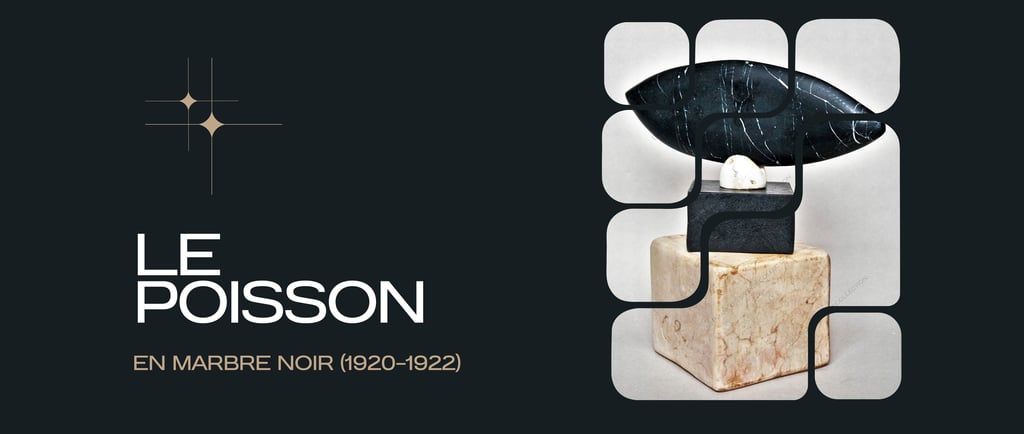
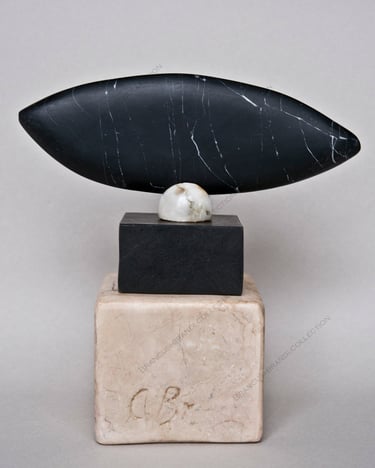
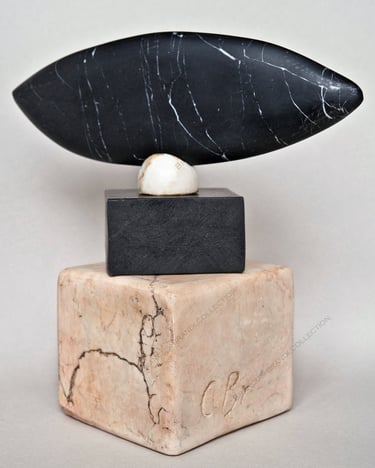
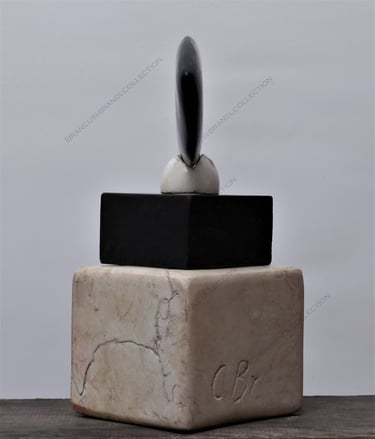
While examining the Fish series, we identified a previously unknown work: an example carved in black marble streaked with fine white veins (Figures A 1–3). Its arc-like, elliptical form evokes the movement of a fish swimming against an underwater current. The sculpture displays a harmonic ratio of 1 : 2.79 : 0.21 and is currently held in a private collection in Paris.
Unique within the series, this sculpture is set into a groove carved into a white marble base, which gives it a high degree of mobility, as it can be easily removed and reinserted. The difference in proportions between this piece and the other known Fish sculptures, as well as its mode of attachment, suggests that the artist had not yet developed a technical solution for securely fixing a relatively thin marble form to its support.
Suspending the sculpture on a metal disc or a marble base allowed its form to be visually elongated, but also required a slight increase in thickness, of approximately 0.5 mm.
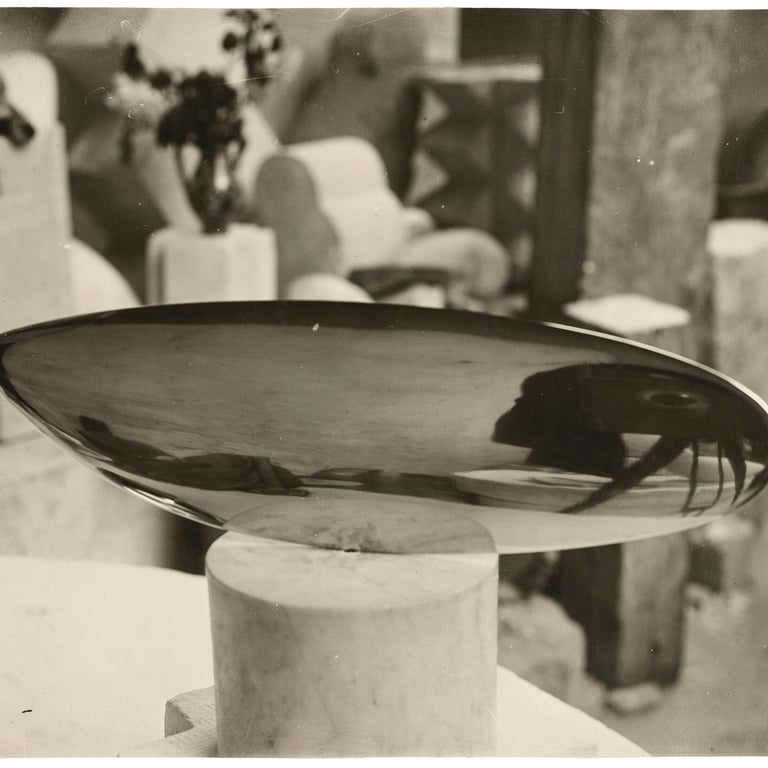
Another argument supporting the hypothesis that the black marble Fish may be the first work in the series lies in photographs of the two sculptures shown in Figures B and C: these were initially suspended on a marble base (a stable, non-detachable fixing). This system was later abandoned in the subsequent bronze versions, before reappearing in the large blue-grey marble Fish.
Description of the Black Marble Fish (1920–1922)
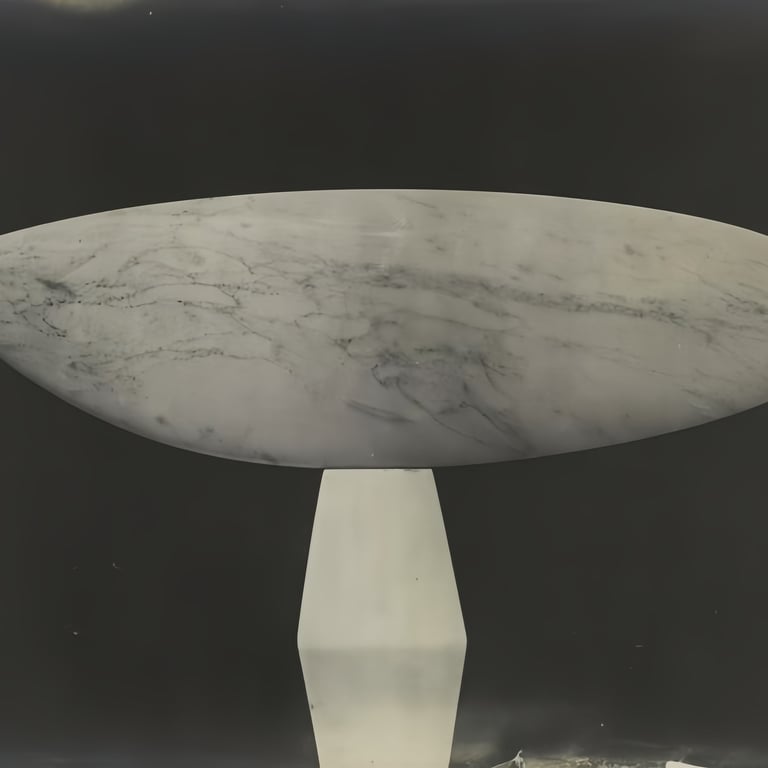
Figures B
Figures C
Figure A-3
Figure A-2
Figure A-1
The base of the black marble Fish also presents a remarkable innovation: it consists of three elements forming a unified whole—at the bottom, a rectangular beige marble parallelepiped (signed C. Br), surmounted by a 4 cm black marble cube, and finally the veined white marble support.
Together, these elements create the impression of a group of stones of differing shapes and colors, evocative of the rocks among which fish move.
Conclusions
In each work of the Fish series, one observes a limited number of constituent elements, a minimalist execution, and a strong dependence on the base. The latter, in contrast to the simplicity of the sculpture itself, is always carefully conceived and meticulously executed. It consists either of a single element (wood or marble) or of several components (marbles of different colors or marble combined with stone).
The bases are relatively low in height, reflecting the fact that fish swim close to the bottom, and the polished surfaces of marble or bronze clearly evoke an aquatic universe.
The sculptures are rigidly fixed to a marble support or to a metal disc.
They were conceived to suggest both the rapid horizontal movement of the fish in its natural environment and its ambush-like posture among the pebbles of the riverbed.
To achieve this effect, the artist employed several technical devices:
— a fixation system reduced to a single point or minimal section;
— the use of mechanical or electrical means intended to set the sculpture in motion, thereby emphasizing its volume and the reflections of the polished bronze.
To these concrete procedures, Brancusi adds two conceptual ways of mentally inducing the idea of movement.
The first lies in the aerodynamic form of the Fish, slicing through the water like a torpedo—as can be seen in Figures A-3, D, and E, where the resemblance is striking between the two sculptures (the black marble Fish, Figure A-3, and the blue-grey marble Fish, Figure D) and a First World War torpedo preserved at the Canadian War Museum in Ottawa (Figure E).

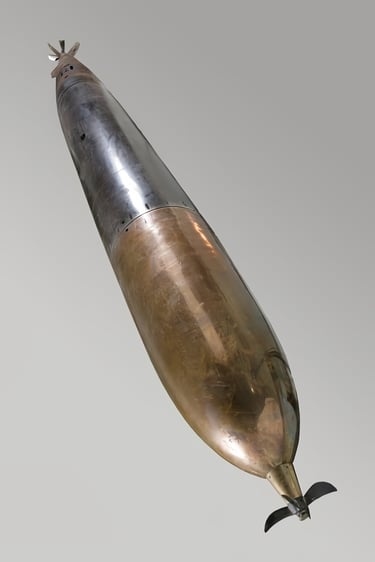
Figure A-3
Figure D
Figure E
Figure A3 and D: Front view of the Fish (1920–1922 and 1930); Figure E: First World War torpedo
What better than a torpedo could symbolize speed and penetration through a medium?
Brancusi, who was well acquainted with their use during the Great War, here transposes this mechanical reference into the realm of the living. Thus, even an aquatic creature can convey the same dynamic of elevation that the artist developed with virtuosity in the Bird series: for every object, every being, contains traits and qualities that must be patiently discovered, through observation from multiple perspectives.
In Brancusi’s case, one observes a process inverse to what is usually encountered: whereas humans typically draw inspiration from nature to achieve remarkable technical performances, Brancusi instead starts from man-made objects and traces them back to their origin—namely nature itself, to the essence of things.
Another essential dimension lies in the choice of materials—veined marble or polished bronze.
The latter, through the play of light incidence and reflection, through alternating shadows and highlights, creates the illusion of fully dynamic movement.
In reality, as he himself once stated, Brancusi did not intend to sculpt the fish itself, but rather “its spirit.”
---------------------------
---------------------------
Other articles you may like
Contact
For any questions, contact us here.
Follow us
Subscribe
© 2025. All Rights Reserved.