
Discover Brancusi’s Legacy



The Feat of Romanian Aviators at Issy-les-Moulineaux
At the beginning of the 20th century, the airfield at Issy-les-Moulineaux witnessed the pioneering achievements of two exceptional Romanian inventors: Traian Vuia, who performed the first flight with an internal combustion engine (1909), and Henri Coandă, who created the first jet-propelled airplane (1910). Their ingenuity helped establish Issy as “the cradle of aviation” and strengthened the ties between France and Romania, united by a shared passion for progress and science. A commemorative plaque at 12 Boulevard des Frères Voisin, opposite the Parc de la Girafe, preserves the memory of these remarkable feats.
TRAIAN VUIAAVIATIONHISTOIRES
10/31/20252 min read
At 12 Boulevard des Frères Voisin, opposite the Parc de la Girafe (formerly the Issy maneuvering grounds, later the Issy airfield, and now the Parc de la Girafe and Paris heliport), a commemorative plaque is affixed to the wall of a building (see below).
The first jet-powered airplane to fly at Issy, December 1910. Ph. XDR.
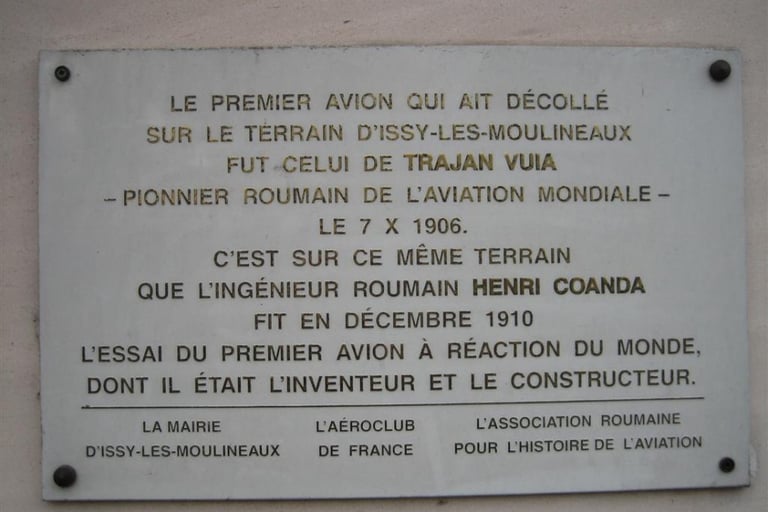
The plaque honors the presence of Romanians at Issy-les-Moulineaux a century ago—particularly in 1906 and 1910—who achieved remarkable feats in aviation, helping to establish Issy-les-Moulineaux as “the cradle of aviation.”
At the time, this presence coincided with a policy of openness and cooperation with Romania (among other countries), a nation often referred to as having France as “the great Latin sister.” The plaque specifically mentions two Romanian pioneers of aviation: Traian Vuia (1872–1950) and Henri Coandă (1886–1972).
Plaque on Boulevard Voisin © Michel Julien
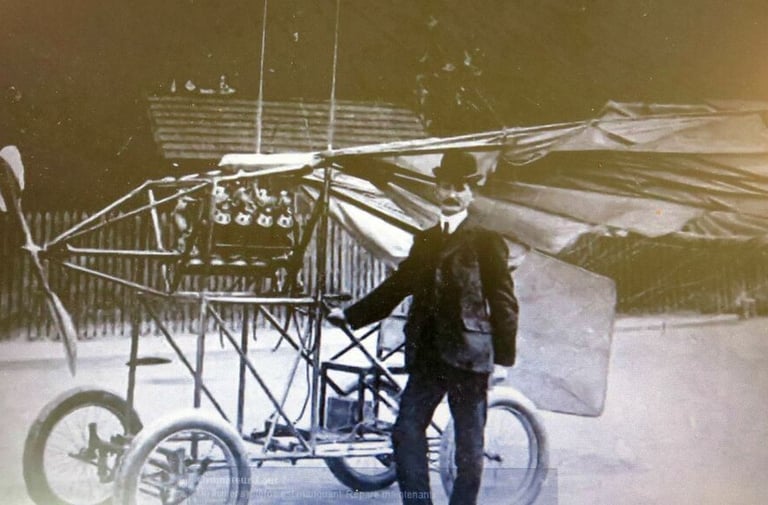
Traian Vuia in front of his airplane, Issy, May 1909
If Clément Ader had managed to take off in 1890, and the Wright brothers had achieved their flights, Traian Vuia (as mentioned above) completed the first powered flight of an airplane using an internal combustion engine. Although this initial flight, carried out in May 1909 at Issy-les-Moulineaux, covered only 25 meters, it marked a pivotal moment in aviation history, proving the potential of this type of engine. Additionally, Vuia’s airplane was equipped with a two-bladed propeller, which was revolutionary at the time. Curiously, the French Academy had once solemnly declared that “the idea of flying something heavier than air was an absurdity beyond words”!
The second story concerns another Romanian aviator, Henri Coandă, a global pioneer of aviation, inventor of jet engines, scientist, and Romanian academician. His father, a mathematician, general, and politician, and his French mother encouraged him to pursue studies that led him to join the new engineering school “SupAéro,” from which he graduated top of his class in 1910.
With the support of Georges Eiffel and the scientist (mathematician and physicist) Paul Painlevé, Coandă invented the first jet-powered aircraft (shown below), which was presented at the 2nd International Aeronautics and Space Exhibition at Paris-Le Bourget in October 1910.
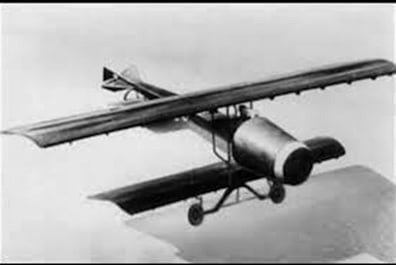
Il en effectue le premier vol, en décembre 1910, sur le terrain d'Issy-les-Moulineaux. Pendant toute sa vie, il inventa aussi bien des avions de reconnaissance qui servirent, dès 1916, à l'armée, que des avions pour Bristol (en Grande-Bretagne), le premier train aérodynamique, des procédés de constructions de maisons préfabriquées, etc. Mais sa passion demeura l'aviation pour laquelle il construisit une usine à côté de Poitiers où il s'installa.
Si on connaissait la présence en France d'intellectuels roumains, d'artistes (allez voir le département des impressionnistes -roumains et français- au musée national de Bucarest!), d'hommes politiques d'origine roumaine, on connaissait peut-être moins celle de la grande école aéronautique roumaine, (d'où ce propos!!). Ils ont chacun donné leur nom à des aéroports en Roumanie : le premier à Timisoara ; le second à Bucarest. - Paul Drezet.
— Published by Historim, January 5, 2014
Other articles you may like
Contact
For any questions, contact us here.
Follow us
Subscribe
© 2025. All Rights Reserved.