
Discover Brancusi’s Legacy



Testimonies - Introduction
Brancusi – Testimonies continues Brancusi: The Beginner by bringing together rare and often unknown accounts of the sculptor’s early works created during his formative years in Romania. Drawing on televised interviews, archival documents, and interdisciplinary research, the volume sheds new light on Brancusi’s Romanian roots and his enduring ties to his homeland. An essential contribution to a deeper and more accurate understanding of Brancusi’s life and artistic legacy.
1/11/20262 min read
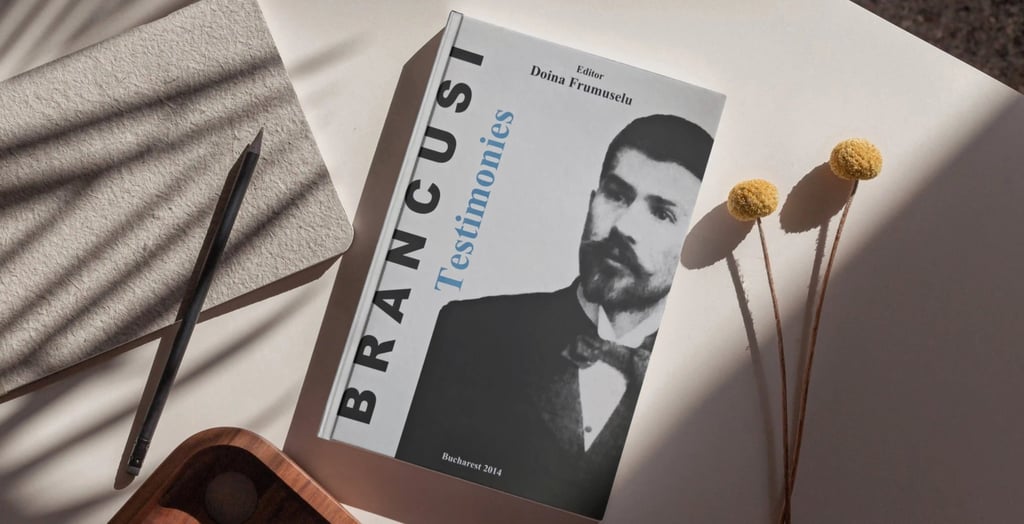
Brancusi – Testimonies is a volume continuing Brancusi: The Beginner published in 2013, as it includes testimonies on the sculptures that Brancusi made during his school years in Romania, which are unknown to art amateurs and even to Brancusiologists. Brancusi has never detached himself from his origin and kept in touch with the country through his family, his participation in Romanian exhibitions, through his friends or his gratitude shown to domestic protectors.
The volume has been structured into five series of biographical testimonies provided into TV broadcasts from 1999 to 2005 attended by the most important art critics and historians, graphic experts, university professors, academicians, sculptors, writers, scientists, a.o. from Romania. The purpose was to introduce the unknown pieces sculpted by Brancusi and studied by an interdisciplinary team from the Institute of Sociology of the Romanian Academy under a grant, entitled 'Brancusi – Romanian gate to the universal – sociological coordinates' registered on May 5, 2000 with the National Agency for Science, Technology and Innovation, as well as the results obtained in this process. There were also attempts to complete the history of each sculpture with new data from the viewers, by discovering new sculptures and documents about Brancusi's life and work. Hopes were to draw the attention and support of responsible people of the national cultural heritage and of other personalities from culture and art.
Interviews from personalities in the artistic, academic, political, theological domains, as well as collectors or responsible persons of the national heritage;
Unknown documents (applications, letters, cards, custom and notary documents written by or related to Brancusi, expertise reports, sale-purchase contracts for certain sculptures, etc.);
A study with respect to the artistic vision and working technique that Brancusi applied when sculpting his Maiastra birds;
The TV broadcasts, filmed interviews, photographic and documentary materials come from the archives of Co. ROMSIT SA, a company that intended investing in art and thus financed and managed the fore-mentioned research study. This company covered also the broadcast costs by state and private TV channels (TVR 1, Tele 7abc, Antenna 1 and OTV). Other documents introduced in the Brancusi – Testimonies volume come from the archives of certain collectors of Brancusi sculptures that remained unknown to date for various reasons, most of them beyond the owners' control.
Cornelia Elena Marinescu, former department head with Co. ROMSIT SA has transcribed the filmed broadcasts and interviews. The resulting materials have been rigorously selected in qualitative terms, which meant removing the discussions besides the point and the errors of Brancusian history, as well as writing them in readable form, operations performed by the book's editor.
The purpose of issuing Brancusi – Testimonies is to bring new evidence showing that Brancusi is far from being well-known, that his Romanian creation is utterly erroneously presented and his early period needs further studies without biased prejudice, providing new passion unaltered by old mentalities from the communist era, which we could not overcome after almost a quarter of a century. Similarly foreign Brancusi experts should confidently approach the original informational sources that can be found only in Romania, not elsewhere. The example set by Sidney Geist is praiseworthy as beginning with 1964 until almost his death he paid constant visits to Romania in order to meet Brancusi at home.
We are certain that open and honest cooperation can only benefit Brancusiology and the entire world of Brancusi admirers, and the great sculptor will be revealed closer to truth!
Dr. Doina Frumuselu
Other articles you may like
Contact
For any questions, contact us here.
Follow us
Subscribe
© 2025. All Rights Reserved.