
Discover Brancusi’s Legacy



Study of the Kiss in the Visual Arts
We encounter the kiss in literature, the arts, cinema, and history, bearing multiple meanings — love, passion, friendship, respect, idolatry, gratitude, betrayal, hypocrisy, and more — throughout the centuries, among philosophers, historians, anthropologists, writers, painters, sculptors, filmmakers, and more recently, scientists.
THE KISSLUCIA BRANDL COLLECTION
10/23/20253 min read


-----------------------------------------------------
Today, there even exists a science dedicated to the study of kissing: philematology.
It was the British who first came up with the idea of dedicating a day to the kiss, and the United Nations officially established July 6 as International Kissing Day.
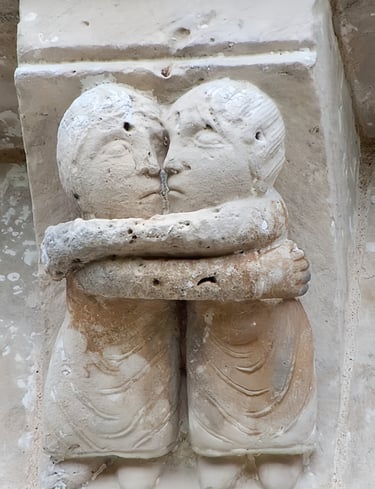
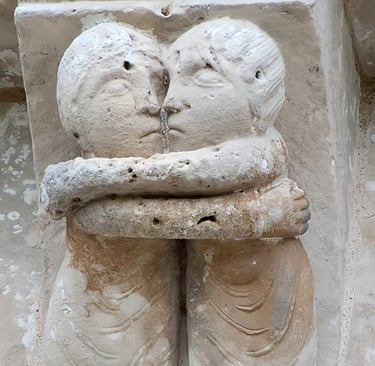
Historical records document the first evidence of kissing in Sanskrit texts dating back approximately 3,500 years. Researchers and art historians have traced the sources of inspiration to ancient or medieval sculpture (for instance, the carved lovers adorning a console on the façade of the twelfth-century Church of Saint-Pierre de la Tour in Aulnay, Figure A), to Platonic philosophy, or to Eastern thought, among others.
The gesture also appears in various symbolic forms: the kiss of the earth, through which the Pope transmits God’s blessing to the country he visits; the kiss on the hand, initiated at royal courts during the Middle Ages; the kiss on the foot, symbolizing submission and/or Christian humility, mentioned in the Bible and observed during religious ceremonies; the kiss of the ring, practiced in the Middle Ages and during papal audiences, always representing respect and submission; and finally, the veneration kiss in Orthodox Christian icon worship.
The Kiss in the Visual Arts
The theme of the Kiss has been addressed by renowned painters and sculptors across the world, beginning in the Middle Ages, where it appeared in both religious and secular scenes marked by the presence of the gods Eros or Amor, legacies of ancient Greece and Rome.
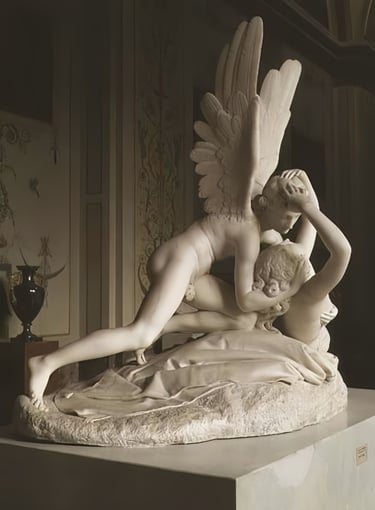
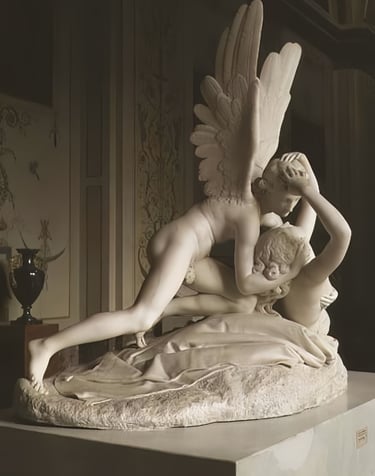
This theme also found expression in neoclassical sculpture (Figure B), as well as in the works of great Impressionist, Post-Impressionist, Modernist, Fauvist, Cubist, and Surrealist artists active between the late nineteenth and early twentieth centuries, extending into the Pop Art era.
Art history has preserved as key reference points The Kiss by Auguste Rodin — which triggered a true revolution in late nineteenth-century sculpture — and The Kiss by Constantin Brancusi, who in 1907 laid the foundations of modern sculpture.
This study seeks to synthesize the evolution and artistic approaches to the theme of the Kiss in the work of sculptor Constantin Brancusi, who devoted nearly his entire artistic life to exploring this motif, transferring it from sculpture to drawing, and eventually to architectural projects.
Among the world’s artistic heritage, ten works have been identified that have entered the collective memory as masterpieces of painting and sculpture (Figures C–L). Each artist expressed their personal vision of the Kiss, shaped by their personality, education, environment, and the artistic movement to which they belonged or by which they were influenced.
It is worth noting that, up until Brancusi, sculpture was primarily figurative and sensual, exerting a strong erotic impact on the viewer — an influence inherited from Rodin, who had provoked the first major artistic revolution since Michelangelo.
In general, artists have represented the kiss as a passionate act. The couples depicted are often nude in sculpture, though more rarely in painting, where nudity is often softened or merely suggested.
The kiss may be consummated in reality or in dreams, lived with equal intensity by both partners — or transformed into torment, when one of them refuses it.
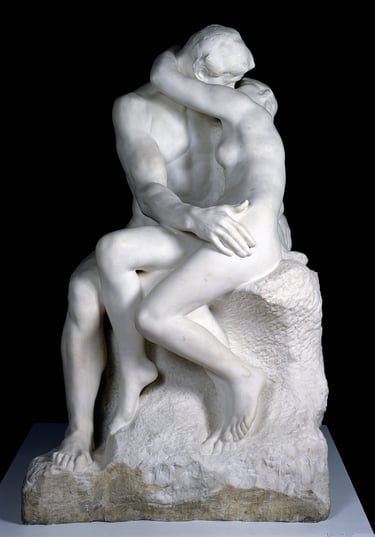
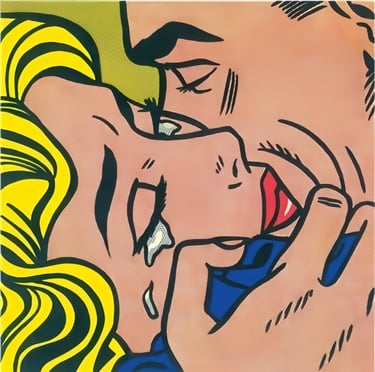
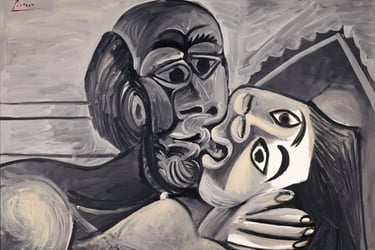
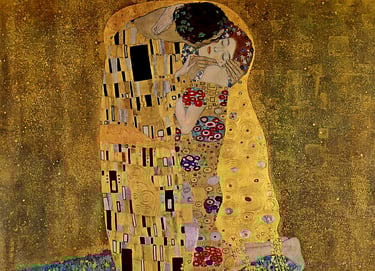
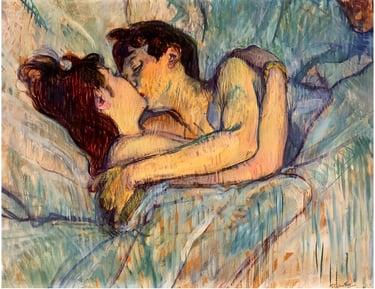

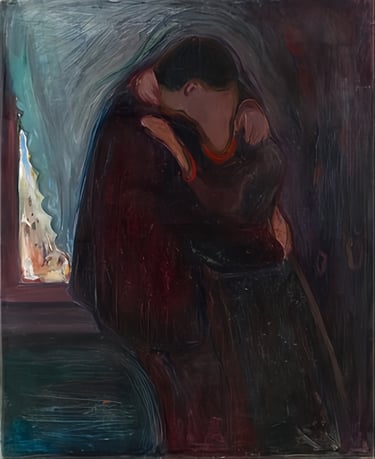
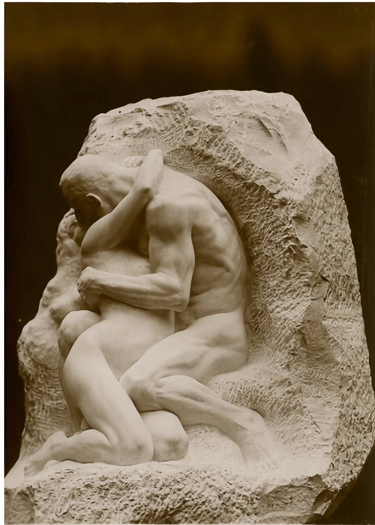
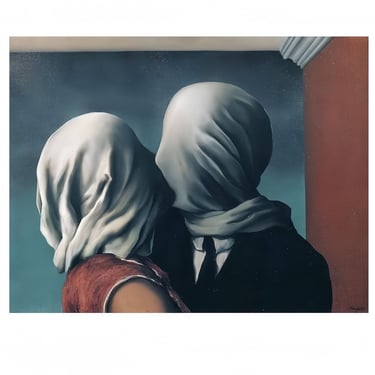
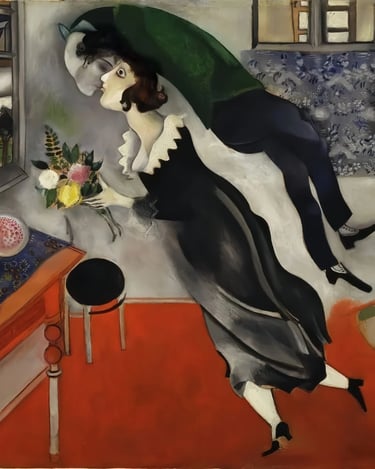
Figure C: Auguste Rodin, The Kiss, 1888–1889
Figure D: Henri de Toulouse-Lautrec, Au lit, le baiser, 1892
FIGURE B: Psyche and Cupid by Antonio Canova, 1796.
Figure E: Émile Derré, Grotte de l’Amour, c. 1900
Figure F: Roy Lichtenstein, The Kiss, 1964
Figure G: Roy Lichtenstein, The Kiss, 1964
Figure H: René Magritte, Les amoureux II, 1928
Figure I: Pablo Picasso, The Kiss, 1969
Figure J: Edvard Munch, The Kiss, 1897
Figure K: Marc Chagall, Anniversary, 1915
Figure L: Gustav Klimt, The Kiss, 1908
FIGURE A: Couple of Lovers, Saint-Pierre de la Tour Church, Aulnay.
Other articles you may like
Contact
For any questions, contact us here.
Follow us
Subscribe
© 2025. All Rights Reserved.