
Discover Brancusi’s Legacy



Night Bird: Analysis of the sculpture De Modi
In De Modi, Night Bird, Brancusi transforms stone into a symbol of elevation and mystery. The article unpacks this rare work, situated between abstraction, energy, and poetry.
12/23/20253 min read
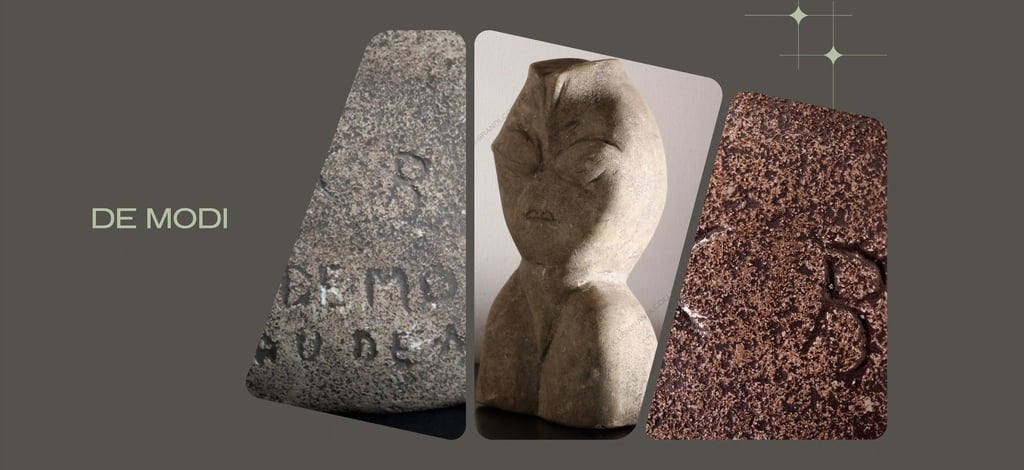
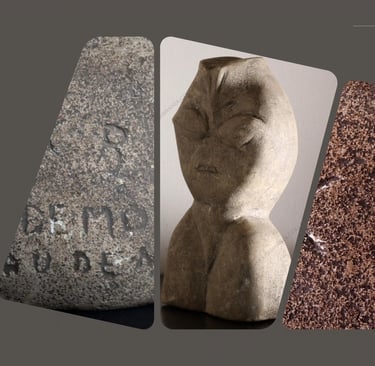
De Modi, Night Bird is an allegorical portrait of Amedeo Modigliani (born 1884 in Livorno, died 1920 in Paris), whom Brancusi met in Paris in 1908 through a mutual friend, Dr. Paul Alexandre (B. Brezianu, 1974, p. 19).
The sculpture can be dated to the period 1909–1914, when Modigliani focused on sculpture, without neglecting drawing and painting, to which he devoted himself exclusively from 1916 until the end of his life.
Between 1909 and 1911, Modigliani worked passionately in Brancusi’s studio, showing a particular interest in direct carving. At that time, Brancusi lived at 54, rue du Montparnasse. Based on its texture and apparent density, De Modi, Night Bird (23.8 × 13.5 × 7.8 cm) is carved from limestone and has no base (Figs. 1a, b). It bears the signature “C. B.” (Fig. 1c), typical of Brancusi’s early works.
To support this attribution, several sculptures bear a similar signature: Prometheus (plaster, 1911, National Museum of Art of Romania, Bucharest), Torse of a Young Man (wood, 1916, Philadelphia Museum of Art), and Adam and Eve (wood, 1916–1919, Solomon R. Guggenheim Museum, New York).
In the archives of ROMSIT S.A. in Bucharest—which funded between 1999 and 2004 a large research program on Brancusi’s work—I found several photographs of works preceding the one dedicated to Modigliani, his talented friend. These include three torsos: two in limestone (Figs. 2 and 3) and one in marble (Fig. 4).

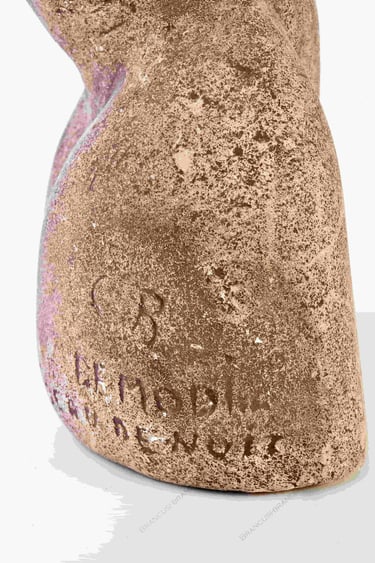
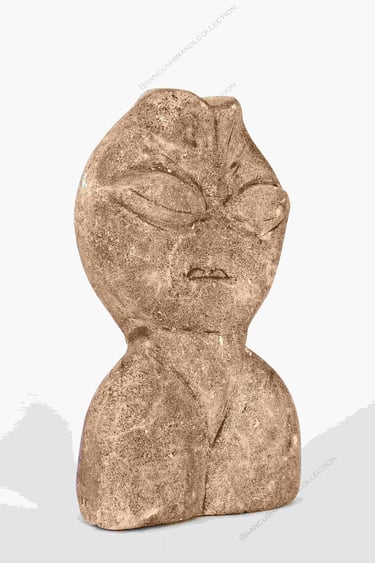
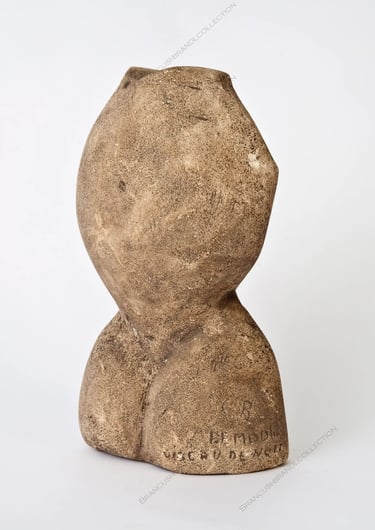
Figs. 1a–d. Sculpture DE MODI, NIGHT BIRD
Fig. 1a
Fig. 1b
Fig. 1c
Fig. 1d
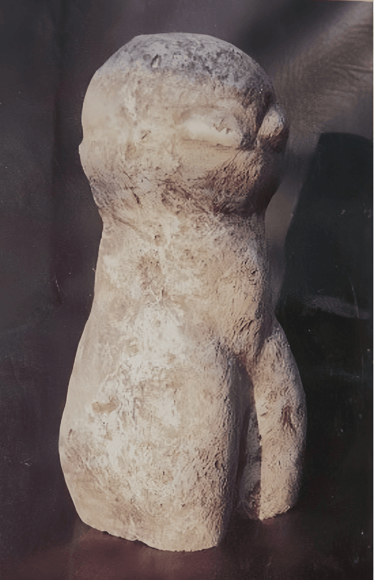
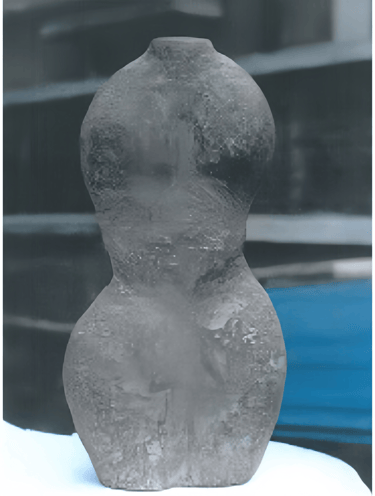
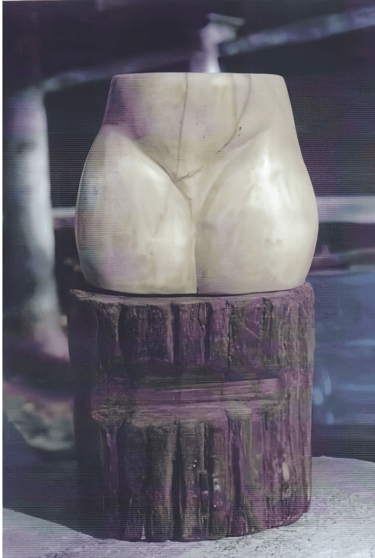
Fig. 2. Torso, limestone, 29.5 × 15 × 11 cm
Fig. 3. Torso, limestone, 16.7 × 14.5 × 10 cm
Fig. 4. Torso, marble, 14.5 × 11 × 13 cm (wooden base, 12 × 11 × 9 cm)
Interpretation of the Work
Interpretation of the Work: This sculpture serves as a portrait in which Brancusi depicts his youngest student—and likely his very first—as he was at the time: a true “night bird.”
This nickname alludes to Modigliani’s chaotic life, marked by alcohol, drugs, women, poverty, and sleepless nights spent in Parisian cafés.
Brancusi chose to represent only Modigliani’s head and torso—the latter recalling a female torso (Fig. 1d). The head, disproportionate to the body, symbolizes Modigliani’s intelligence, genius, and creativity. The slit at the top of the head visually illustrates a Romanian proverb: “So intelligent that his head might burst.”
The large, protruding eyes evoke the artist’s nocturnal lifestyle, inspired by the eyes of night birds. These enlarged eyes and the fine mouth are characteristic features of Brancusi’s early work, inherited from Byzantine iconography—what V. G. Paleolog referred to as “pre-Pogany eyes.”
The feminine torso represents Modigliani’s overflowing sensuality, which made him dependent on women. Aware of his fragile health, he sought to live intensely during the short time he had.
Dialogue and Testimonies
Peter Neagoe, childhood friend and colleague of Brancusi, recounts the sculptor’s relentless—sometimes desperate—efforts to save his student from self-destruction. He records a striking dialogue between the two artists:
“You cannot attain perfection while living in sin. Asceticism is essential. As you learn to master your body, your will will strengthen. [...]”
Modigliani replied:
“You think I could sit cross-legged for an entire month? That would kill me! Life must be lived.”
Brancusi responded:
“You are going to destroy yourself. Life is an illusion; it must be mastered. [...] Try to subjugate your self, and you will be free.”
To which Modigliani concluded:
“That is your path, not mine. You will live long; I will die young. Each of us must follow his own way. I am like a bee: there are too many flowers to taste to stay in one place.”
Contexte et création
Context and Creation: Among the essential testimonies, those of V. G. Paleolog, Brancusi’s first interpreter and loyal friend, are fundamental. In an interview with Romulus Rusan, Paleolog recalled his introduction to Brancusi through Modigliani:
“I presented myself as being from Constantinople. Modigliani saw through me: ‘You are Romanian? My master is too: Brancusi.’ A few days later, I met him in his studio…”
This encounter marked the beginning of a long friendship, filled with passionate exchanges about art and life.
In February 1908, Brancusi contracted typhus in Paris but survived. During the summer, he returned to Romania to recover and worked in the studio of the collector Alexandru Bogdan-Piteşti in Bucharest. There, he sculpted La Danaïde and probably De Modi, Night Bird.
Both sculptures remained in Romania: La Danaïde was acquired by Bogdan-Piteşti, while De Modi disappeared, only to be rediscovered in 1990, after the fall of the communist regime.
Epilogue
The friendship between Brancusi and Modigliani cooled after 1914, due to the latter’s self-destructive behavior and his refusal to change his lifestyle. Added to this were the upheavals of the First World War.
V. G. Paleolog recounts a violent episode in 1911, when an exasperated Brancusi shouted at Modigliani:
“Go and paint, for you will never be a sculptor!”
(V. G. Paleolog, 1973, pp. 49–50)
Other articles you may like
Contact
For any questions, contact us here.
Follow us
Subscribe
© 2025. All Rights Reserved.