
Discover Brancusi’s Legacy



Description of Traian Vuia in marble (ca. 1906–1907)
Traian Vuia by Brancusi is a small white marble portrait (22 cm) that combines a sense of monumentality with pre-Cubist stylization. The sculpture evokes the inventive spirit of the pioneer, symbolized by a prominent nose and a gaze turned toward the sky.
12/18/20251 min read
According to Brancusi’s vision, Traian Vuia is a small-scale work (22 cm in height and 14 cm in diameter at the base), yet one of striking monumentality and grandeur. The absence of a pedestal enhances this impression, while the circular base—slightly wider than the upper part (12 cm in diameter)—gives the volume stability and a grounding that evokes the massiveness of a sphinx.
Brancusi depicts Traian Vuia as a man-bird: the large nose alludes both to his flying machine and to his curious, inventive researcher’s mind. The implied gaze, directed upward, and the nose shaped like a large bird’s beak, oriented toward the sky, together with the prominent chest projecting into space, give the figure the appearance of an eagle at rest.
Depending on the viewing angle, the sculpture reveals a succession of arches, circles, straight lines, and sharp angles which, when combined, form various geometric configurations of pre-Cubist influence. These elements, together with historical data, make it possible to estimate the period of creation of the work as 1906–1907.
Executed in white marble, the sculpture displays a pinkish-brown patina and retains traces of ochre paint (clay used as a pigment), a technique Brancusi practiced under the influence of painted ancient statues, before abandoning it when he began to focus on the intrinsic structure of materials.
The work is signed by incision “C. Br” at the lower left, in keeping with the sculptor’s practice at the time. The surface of the base also bears a dedicatory inscription: “Lui T. Vuia” (“To T. Vuia”).
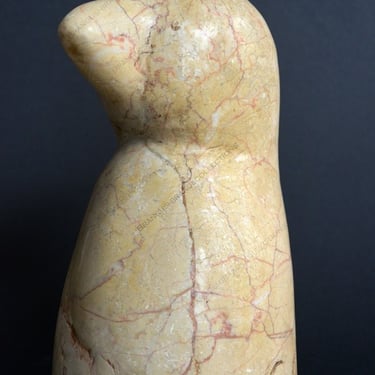
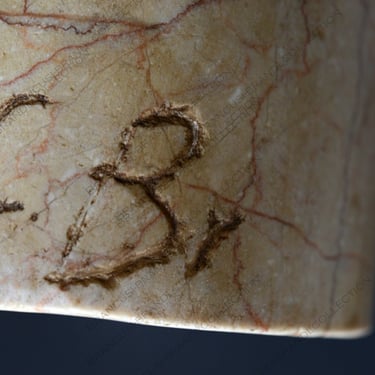
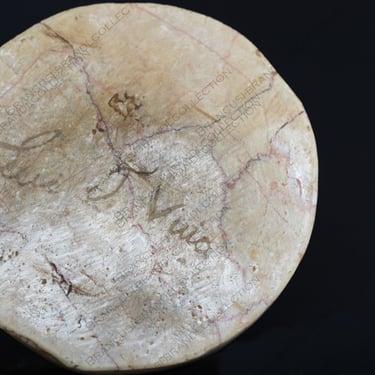
Figure A-1
Articles Similaires
Contact
For any questions, contact us here.
Follow us
Subscribe
© 2025. All Rights Reserved.