
Discover Brancusi’s Legacy



Brancusi’s The Kiss or the Road to Damascus
- The Spiritual Revelation of a Modern Sculpture Genius- Brancusi was the first modern sculptor to explore the theme of the kiss extensively, dedicating nearly fifty years to the subject with nine stone sculptures and several plaster casts, forming the famous Kiss series. The year 1907 marked a turning point with works such as Head of a Young Girl (lost), The Kiss, and The Wisdom of the Earth, among his earliest direct-carving pieces, executed without preliminary sketches or measurements. For Brancusi, The Kiss represents his “Damascus Road,” an allusion to the biblical conversion of Saul on the road to Damascus, symbolizing his own artistic revelation. Unlike Rodin’s sensual, dynamic Kiss, Brancusi’s version embodies transcendent love, stability, and eternity.
THE KISSLUCIA BRANDL COLLECTION
10/31/20254 min read
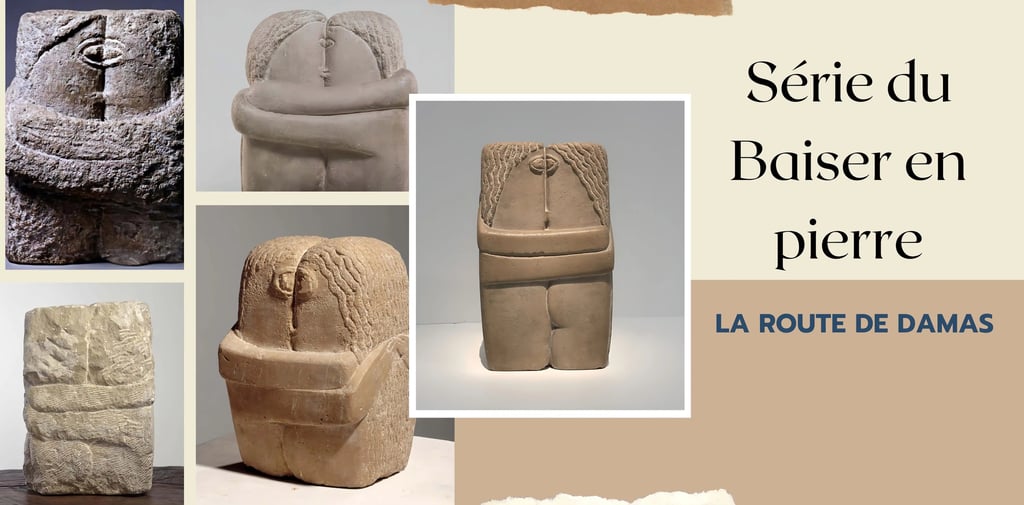
Among visual artists, Brancusi was the first to deeply explore the theme of the Kiss, which remained central to his work for nearly fifty years. During this period, he created nine stone sculptures and several plaster casts, forming the celebrated Kiss series.
The year 1907 marks a turning point: he executed Head of a Young Girl (lost), The Kiss, and The Wisdom of the Earth, among his earliest direct-carving works—created without preliminary sketches or measurements. For Brancusi, The Kiss represents his “Road to Damascus,” a spiritual journey in which he captured the essence of things. This expression, drawn from the Acts of the Apostles, recalls Saul’s miraculous conversion on the road to Damascus. Similarly, Brancusi experienced a profound vision while sculpting The Kiss, producing a work of transcendental love that distanced him from his mentor Rodin, whose Kiss he considered overly carnal and passionate.
In 1910, the sculpture was sent to Romania to participate in the Autumn Exhibition of the Jeunesse Artistique Society, under the patronage of Princess Marie of Romania (November 14 – December). It appeared under the title Fragment of a Capital, in stone. Brancusi’s international fame, however, solidified after a plaster variant was shown at the 1913 Armory Show in New York.
Stone Kiss Series
Brancusi’s 1907 The Kiss marks the beginning of his renowned stone series, culminating with La Borne Frontière (1945). This series has been reconstructed by cross-referencing data published by V. G. Paleolog, Mircea Deac, Sidney Geist, P. Hulten, Natalia Dumitrescu, Al. Istrati, Barbu Brezianu, F. T. Bach, Margit Rowell, Ann Temkin, along with information from museums and galleries worldwide that hold Brancusi’s works (Figures A–I).
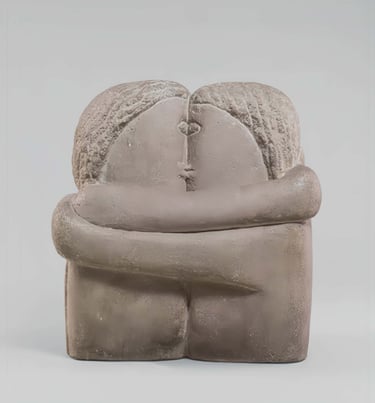
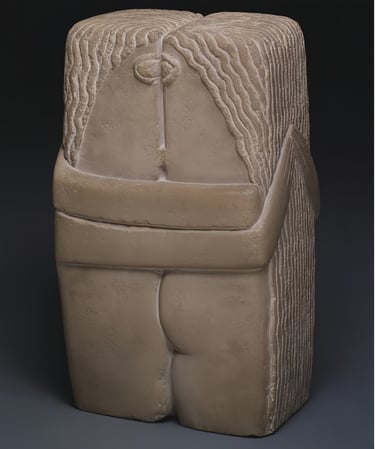

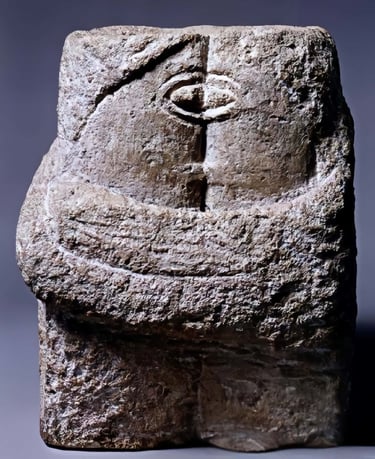
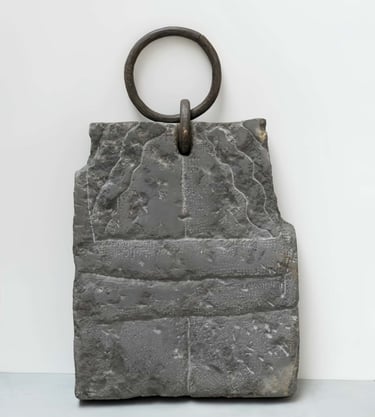
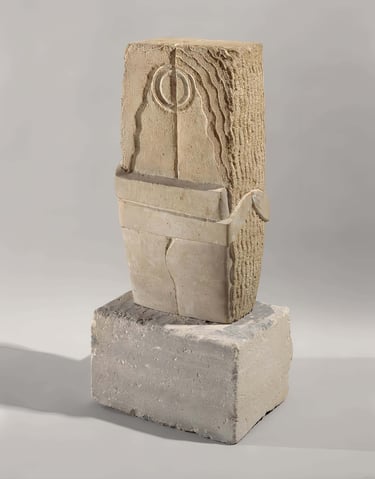
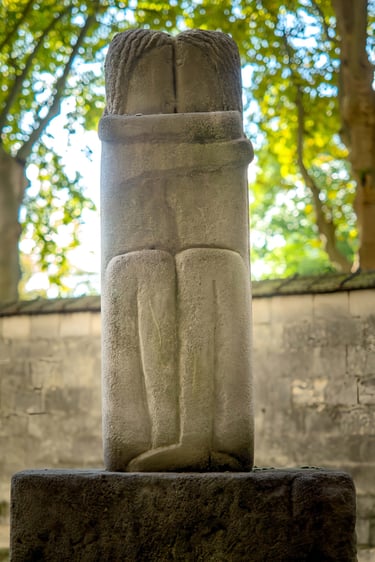

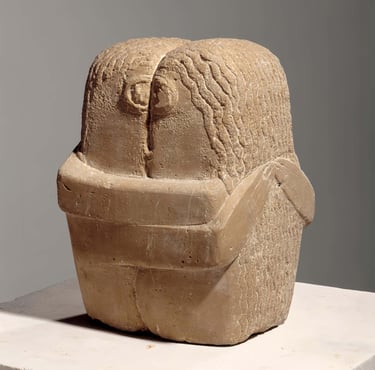
FIGURE A: The Kiss, marlstone, 1907; dimensions: 28.0 × 25.0 × 21.5 cm; signed “Brancusi” at the base, undated (Craiova Art Museum).
FIGURE B: The Kiss, gray limestone, 1908; dimensions: 32.4 × 26.0 × 21.5 cm (Harold and Hester Diamond Collection, New York).
FIGURE C: The Kiss, limestone, 1909; dimensions: 89.5 × 29.7 × 22.7 cm; limestone base: 155 × 64 × 33 cm; signed “C. BRÂNCUŞI” on the base, dated 191–1910 (Montparnasse Cemetery, Paris).
FIGURE D: The Kiss, gray limestone, 1912; dimensions: 58.4 × 33.7 × 25.4 cm; signed “C. Brancusi”, undated (Philadelphia Museum of Art).
FIGURE E: Medallion (The Kiss), volcanic stone, 1919; double steel ring; dimensions: 58.5 × 47.5 × 9.3 cm (Centre Pompidou, Atelier Brancusi, Paris).
FIGURE F: Study (The Kiss), limestone, 1920; dimensions: 39.5 × 27 × 25 cm (Centre Pompidou, Atelier Brancusi, Paris).
FIGURE G: Boundary Stone (Borne frontière), gray and yellow limestone, 1945; dimensions: 184.5 × 41 × 30.5 cm; unsigned, undated (Centre Pompidou, Atelier Brancusi, Paris).
FIGURE H: The Kiss, yellow limestone, 1940; dimensions: 71.8 × 35.2 × 25.9 cm (Centre Pompidou, Atelier Brancusi, Paris).
FIGURE I: The Kiss, gray limestone, 1923–1925; dimensions: 36.6 × 25.6 × 24 cm; signed and dated “C. Brancusi PARIS 1925” (Centre Pompidou, Atelier Brancusi, Paris).
The First Kiss (Figure A):
Sculpted shortly after Brancusi left Rodin’s studio—where he worked from March 24 to April 27, 1907—The First Kiss represents his true declaration of independence from his master. Through this work, Brancusi demonstrates that he has completely freed himself from Rodin’s influence, without diminishing the respect he held for him—Rodin being one of the main reasons Brancusi chose Paris to advance his artistic training.
He boldly manifests this independence by choosing limestone, a simple, unpolished stone with a rough texture, instead of marble, a noble and refined material. The chosen dimensions (height 28 cm, width 25 cm, depth 21.5 cm) give the sculpture a compact, almost cubic form, contrasting with the monumental proportions of Rodin’s Kiss. By foregoing details, Brancusi opposes Rodin’s complexity and realism: where Rodin evokes movement and passion, Brancusi inspires stability, durability, and eternity.
Initially, Brancusi designed a pedestal for the 1907 Kiss, as shown in a photograph of his Paris studio. He later abandoned it to affirm that exalted, transcendental love needs no earthly support. Thus, in 1910, he exhibited the sculpture in Bucharest without a base.
The two lovers are distinguished by the shape, length, and arrangement of their hair:
The man has short hair falling over his forehead.
The woman has long, wavy hair combed toward the nape, making her appear slightly taller.
They cover each other’s eyes, their lips meet, and the woman’s chest presses gently against the man’s. The slightly carved, rounded eyes suggest that the woman’s eyes are open, while the man’s are closed.
A Unique Series in Brancusi’s Work
This series is unique in Brancusi’s oeuvre, comprising nine freestanding stone sculptures with varied textures and tones (gray and yellow). The collection includes:
Funerary stele Kiss
Kiss medallion
Kiss maquette
Kiss column (or La Borne Frontière)
Sculpted between 1907 and 1940, the works share dimensional characteristics: depth remains nearly constant (maximum variation 4.4 cm), width varies little (maximum 10.2 cm), while height changes more noticeably (maximum 43.6 cm) without affecting essential traits. Compared to the first Kiss (1907), subsequent works become increasingly simplified and stylized. Almond-shaped eyes carved in stone (Figure B) evolve into fused semi-circular lines forming a cyclopean eye (Figures D, G, H, I). The arms gradually flatten, nearly merging into the mass, while the line separating the lovers becomes ever finer.
Emblematic Variants
A singular work in the series is the stele sculpture on Tania Rachevskaïa’s tomb (Figure C) at Montparnasse Cemetery in Paris. Approximately three times taller than the other pieces, it shows the lovers’ full bodies, with feet reminiscent of The Wisdom of the Earth (1907). For perspective, the sculpture rests on a 155 cm soft base.
The Medallion Kiss (Figure E) holds a special place in the series, likely conceived by Brancusi as a talisman, symbolizing eternal love and union.
La Borne Frontière: A Spiritual Testament
La Borne Frontière (Figure G) is the final piece in the Kiss series. Composed of three stacked limestone blocks, each face bears the engraved symbol of the kiss. This sculpture can be seen as the artist’s spiritual testament, completed in 1945 at the end of a war that had deeply affected him. The nuclear catastrophe of Hiroshima and Nagasaki had just occurred, and Romania emerged from the war mutilated and divided. Brancusi, increasingly solitary, appeared disillusioned and withdrawn, dissatisfied with the modern world in which he no longer felt at home.
Thus, La Borne Frontière symbolizes a boundary between two worlds:
On one side, the realm of love, beauty, and creation, where Brancusi achieved fame among the greatest artistic figures.
On the other, an uncertain and disenchanted post-war world, which he foresaw but could not fully imagine, already fearing it might be no better than the world before.
Other articles you may like
Contact
For any questions, contact us here.
Follow us
Subscribe
© 2025. All Rights Reserved.