
Discover Brancusi’s Legacy



Analysis of Brancusi’s Fish Sculpture Series
Brancusi was drawn to the fish due to its connection with nature, its Christian symbolism, and its fertility, as well as because it reflected his astrological sign, Pisces, representing his identity and creative aspirations. These elements inspired his imagination and artistic philosophy.
10/30/20255 min read


Introduction
From his childhood, Constantin Brancusi was closely attuned to the animal world—both those present in his parents’ courtyard and those he encountered while wandering through the village. He observed them attentively, showing a particular interest in creatures that seemed defenseless yet were endowed by the Creator with distinctive traits allowing them to survive.
These animals captured the young Constantin’s attention, as his heart and mind were open to the silent world of wild nature. Over time, these small creatures became for him subjects of study and even philosophical reflection, and the working techniques he developed were aimed primarily at capturing the traits that fascinated him in birds, fish, seals, and turtles.
Alongside birds, the fish became the focus of a remarkable series of sculptures.
Why the Fish Theme in Brancusi’s Work?
Like all Romanian peasant children, Brancusi received an Orthodox Christian education and lived in close contact with nature. In Hobița, his favorite playground and place of observation was the grove along the Bistrița River, which flows near his village.
How many times was he seen, breathless, watching the elongated fish play in the mountain waters, their scales gleaming like silver under the bright sunlight… or their swift, torpedo-like passages through the crystalline water… or even their motionless ambushes? All these images fascinated him and nourished a child’s imagination—they never fade.
The fish is also a symbol of Christianity, its outline serving as a secret sign of recognition among early Christians during times of persecution (Fig. 1). Furthermore, because of the large number of eggs it lays, it symbolizes life and fertility.
Abundant and freely caught, fish were considered the food of modest people. Even today, in the Gorj region, an old custom is maintained: eating fish on New Year’s Day to be as lively and agile as the fish and to overcome life’s challenges with its swiftness.


Fig. 1: Fish, a Symbol of Christianity
Astrologically, Brancusi was born under the sign of Pisces, ruled by Jupiter (February 21), a sign said to bestow aspirations for glory and respect.
Petre Pandrea, a lawyer, sociologist, philosopher, and close friend of the artist, believed that Brancusi’s fish were in fact statues representing his zodiac sign.
The scholar Carola Giedion-Welcker also reports that Brancusi himself referred to the fish as his “coat of arms.”
All of this helps us understand why Brancusi was so drawn to this subject and why he created the Fish series.
The Fish Sculpture Series
After the bombing of Paris in June 1918, Brancusi accepted an invitation from Odette de Saint-Paul, a friend of Léonie Ricou, to stay at her house in Chausse (Gard department) to oversee the restoration of her home.
On July 8, while alone in the attic of Odette’s house, the artist broke his leg. In August, he was hospitalized in Alès, then in September at Necker Hospital in Paris; afterward, he spent some time recovering in his studio [3].
Being found and transported to the hospital was, for him, a miracle—one of many he believed he had experienced in his life. It is therefore thought that he sculpted the Fish shortly thereafter as a gesture of gratitude toward the zodiac sign under which he was born.
Catalogues of Brancusi’s works published to date, along with information from museums and galleries holding his pieces, have allowed the reconstruction of the Fish series, which the artist devoted himself to for over a decade.
Historically, the series begins in 1922 with a piece in yellow-veined marble (Fig. 2a, b), with artistic proportions of height : length : thickness = 1 : 3.37 : 0.21.
Between 1924 and 1926, he created five bronze sculptures cast from plaster molds (Fig. 3), with proportions of 1 : 3.34 : 0.23.
The series concludes in 1930 with a monumental sculpture in blue-gray marble with horizontal veining (Fig. 8), displaying proportions of 1 : 3.35 : 0.24.
Description of the Fish Series
Fish (Le Poisson, 1922, Fig. 2a, b)
Yellow-veined marble on mirrored disc and oak base.
Dimensions: 12.7 × 42.8 × 2.7 cm.
No inscriptions.
Original collection: John Quinn, New York.
Current collection: Philadelphia Museum of Art (Louise & Walter Arensberg Collection, 1950)
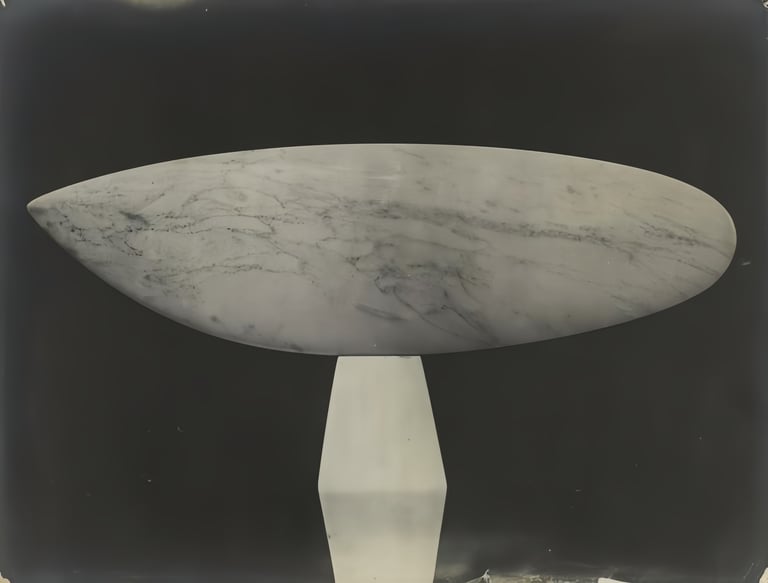
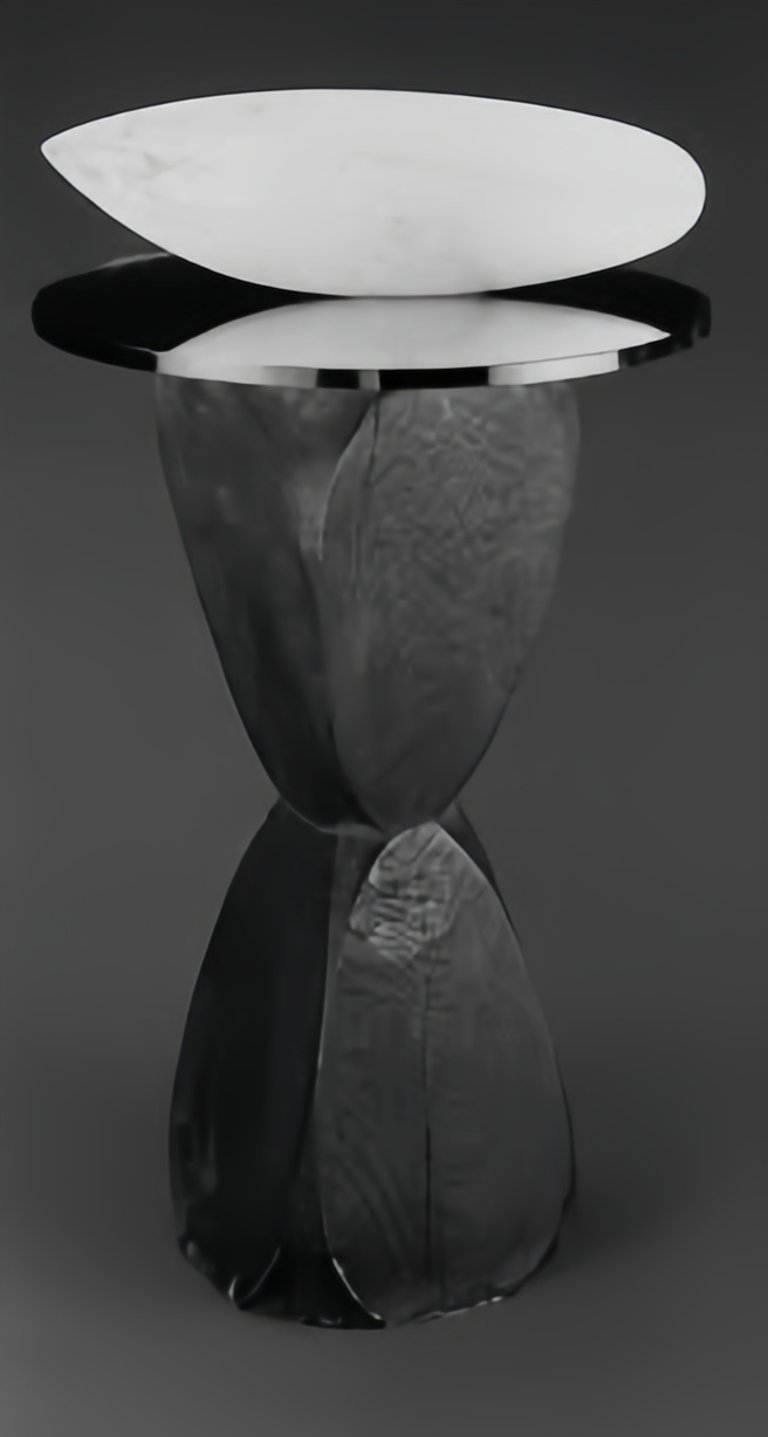
Fig. 2a
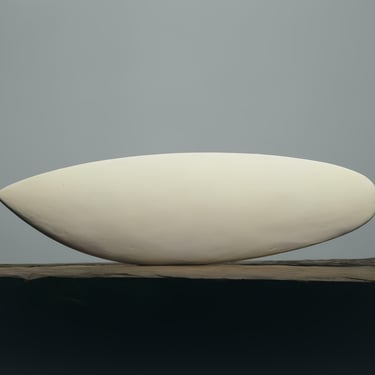
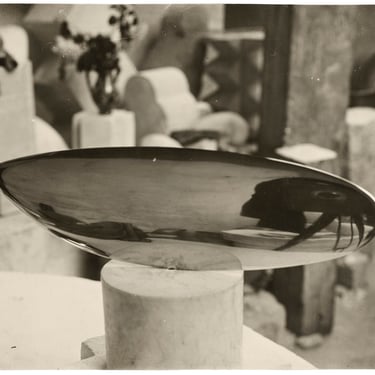
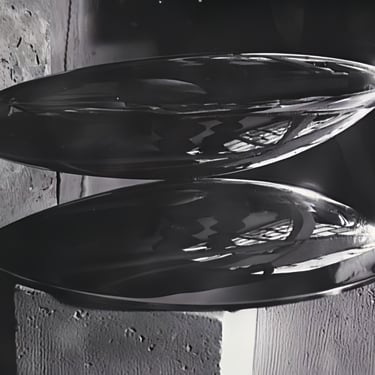
Poisson (Le Poisson, 1924, Fig. 3), Plâtre.
Dimensions : 13,0 × 43,5 × 3,0 cm.
Aucune inscription.
Collection : Centre Pompidou, Paris.
Poisson (Le Poisson, 1924, Fig. 4) Bronze poli.
Dimensions : 12,7 × 42,9 × 2,9 cm.
Inscription : N. 1 C. BRANCUSI – PARIS – 1924.
Collection initiale : Mary H. Rumsey, New York.
Collection actuelle : collection privée.
Poisson (Le Poisson, 1924, Fig. 5) , Bronze poli.
Dimensions : 12,6 × 42,0 × 3,0 cm.
Inscription sur le disque métallique poli : N. 2 C. BRANCUSI – PARIS – 1924.
Collection initiale : Jim S. Ede, Cambridge (Royaume-Uni).
Œuvre aujourd’hui disparue.
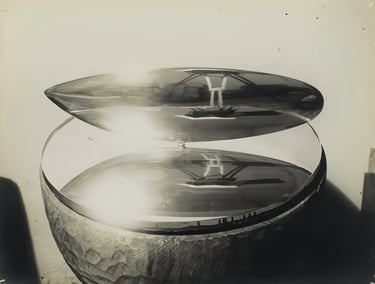
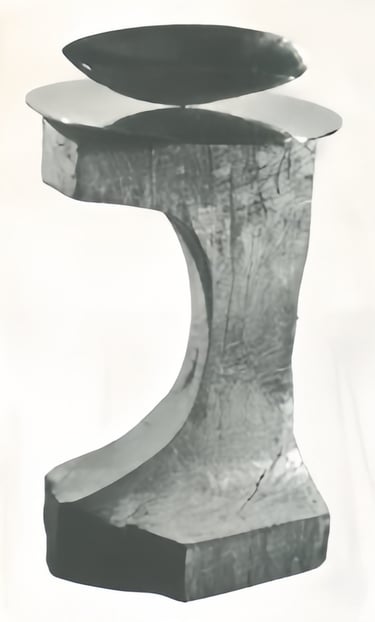
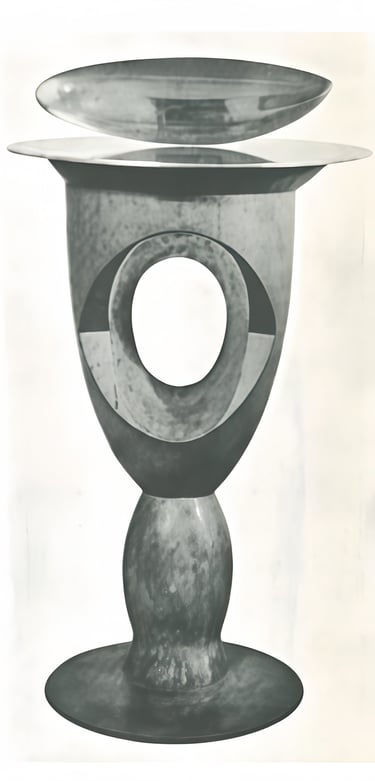
Fig. 6a
Fig. 6b
Fig. 7
Fish (Le Poisson, 1926, Fig. 6a, b)
Polished bronze.
Dimensions: 12.6 × 42.2 × 3.0 cm.
Inscription on the polished metal disc: C. BRANCUSI 1926.
Original collection: Pierre Matisse Gallery, New York.
Current collection: private collection.
Fish (Le Poisson, 1926, Fig. 7)
Polished bronze on a polished metal disc with wooden base.
Dimensions: 12.7 × 40.7 × 3.0 cm.
No inscription.
Original collection: Mr & Mrs Lee A. Ault, New York.
Current collection: Tate Gallery, London.


Poisson (Le Poisson, 1930, Fig. 8)
Marbre veiné bleu-gris sur socle en marbre et pierre.
Dimensions : 53,7 × 180,3 × 13,0 cm.
Inscription : C. Brancusi Paris 1930.
Collection : Museum of Modern Art, New York.
Fig. 3
Fig. 4
Fig. 5
Fig. 2b
Fig. 8
Fig. 9
Poisson (Le Poisson, après 1930, fig. 9)
Plâtre (gypse).
Dimensions : 63,0 × 183,0 × 13,0 cm.
Aucune inscription.
Collection : Centre Pompidou, Paris.
The works in this series share distinctive characteristics:
Sculpted from elongated blocks of marble or cast in bronze, they feature an ellipsoidal outline—tapered at one end and more rounded at the other.
The material’s thickness (in the case of marble) is reduced as much as possible without compromising structural integrity.
The sculptures are intended to convey maximum elasticity through their shape, dimensions, and the play of light across their surfaces.
The 1930 Fish, with its blue-gray marble and monumental size, appears to represent a creature shaped by the aquatic environment, with a static yet undulating character. Its form and proportions indicate that it was designed for public display rather than for an interior setting.
Brancusi never considered a series truly finished; he constantly sought to bring something new to each piece. Evidence of this is the plaster Fish (Fig. 9), modeled with the intention of producing one or more bronze casts.
Critic Sidney Geist remarked:
"But the Fish, while a poetic version, is essentially an image of fluidity, buoyancy, and frictionless passage."
---------------------------------
-----------------------------------------------------
-----------------------------------------------------
-----------------------------------------------------
-----------------------------------------------------
-----------------------------------------------------
-----------------------------------------------------
-----------------------------------------------------
Other articles you may like
Contact
For any questions, contact us here.
Follow us
Subscribe
© 2025. All Rights Reserved.